
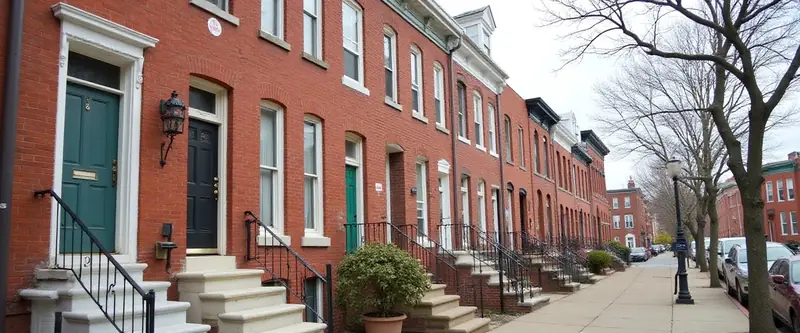
Start with the jurisdiction, not the address
Ask ten out-of-state investors where Baltimore ends and most will point at a map of the region. In Maryland the line is legal, not geographic. Baltimore City separated from Baltimore County as a governmental unit in 1851, and since the state constitution adopted that year the city has been treated as the equal of a county. It has its own transfer tax, its own property tax rate, its own housing department and its own land records. Baltimore County has a separate government with separate rules.
That matters before you look at a single comparable sale, because it changes how much a lender will put into the deal.
Baltimore County is on our lending partner's list of counties where leverage is capped at 50 percent. On a property in the county, plan on the loan covering no more than half of value, and on bringing the rest yourself.
Baltimore City is not named on that list. Because the city is its own jurisdiction rather than part of the county, the county cap does not automatically follow a city address. It does not mean full leverage is assured either: for a property inside the city limits, the leverage is confirmed deal by deal when the lender's team reviews the file.
A "Baltimore, MD" mailing address does not answer the question. Look up the property on the State Department of Assessments and Taxation (SDAT) real property search and note the jurisdiction on the record. Put that jurisdiction at the top of the deal you send in, because it decides how much cash you need before anything else does.
The city market, in its own numbers
Regional headlines describe a market Baltimore City is only one part of. Bright MLS reported a September 2026 median sold price of $405,000 for the Baltimore metro area, unchanged on a year earlier, and homes across its wider region sold in a median of 19 days. Statewide, Maryland REALTORS reported an August 2026 median of $445,000, sales down 8.5 percent on the year and about three months of inventory.
The city itself runs at a different price level. Live Baltimore's analysis of Bright MLS data counted 7,155 city home sales in 2025 at a median of $235,000, up from $220,000 in 2024, with homes averaging 44 days on market against 38 the year before. The spread inside that median is wide: Guilford's 2025 median was $895,000, Canton led the city with 368 sales, and Belair-Edison followed with 175.
For a flipper, the takeaway is that Baltimore City is a block-by-block market. A citywide median tells you very little about what your finished house will sell for. Build the after-repair value from recent sales on the same and neighboring blocks, and be honest about how long the resale took.
Where the $100,000 floor bites
Our lending partner requires an after-repair value of at least $100,000. In most of the country that is a footnote. In Baltimore City it is a real filter, because the city's lowest-priced blocks are exactly where the cheapest purchases are found.
A rowhouse bought for very little looks like a large margin until you ask what the finished house will sell for. If renovated houses on that block resell below $100,000, the deal falls outside the program however cheap the purchase was. If they resell just above it, the appraisal will decide whether the file works, and a thin cushion leaves no room for a low value.
Before you send a low-priced city deal, gather three things: recent sales of renovated houses on the block, a written scope of work that matches those houses, and a realistic resale or rent figure. Those three answer the question the lender asks first.

Vacant buildings: the notice, the permit and the new tax
When a Baltimore City house is cheap because it is vacant, the discount comes with obligations: the city treats vacancy as a legal status with costs attached.
The vacant building notice. The Department of Housing and Community Development places a vacant building notice on a property that is vacant, abandoned and uninhabitable. It is a code violation, and it stays on the property until the work is done and any fines are paid. The department says owners who do not remove a notice can be fined $1,000. Removing it takes proper building permits and, at the end, a final use and occupancy permit showing the house is habitable and up to code.
Disclosure works in the buyer's favor. Under Council Bill 21-0078, a seller must disclose a vacant building notice in the contract of sale, and a buyer can walk away from the contract if the seller still has to abate it. The department advises buyers to check the city's CoDeMap and to read the lien sheet before settlement, where a violation notice will appear.
The vacant property tax. Baltimore has added a special property tax on vacant structures and vacant lots. When the council approved it in 2024, the Maryland Association of Counties reported that it would start at three times the full rate in the 2026 to 2027 tax year, then rise to four times, which is the rate now written in the City Code. At the city's fiscal 2027 rate of $2.248 per $100 of assessed value, three times is about $6.74 per $100 and four times about $8.99. Ask the city which multiple applies to the bill you would inherit. The code defines a vacant structure as one that is unoccupied and unsafe or unfit for habitation.
Put together, the timeline from purchase to use and occupancy permit is not just a rehab schedule; it can be a tax schedule too. Ask the city how the property is currently classified, budget for the notice's fines and permits, and treat the final inspection date as the date your carrying costs start to fall.
Working a Baltimore deal?
Send the address, whether it is in the city or the county, your price, the repair budget and your exit. Our lending partner's team reviews it and tells you whether it fits and on what terms. The lender makes every credit decision.
Closing taxes: the city costs more than the county
Maryland's state transfer tax is 0.5 percent of the price. Above that, the city and county each add their own taxes, and they are not the same.
- Baltimore City: a 1.5 percent city transfer tax, so 2 percent combined with the state, plus a recordation tax of $5 for each $500 of consideration, about 1 percent more. That is roughly 3 percent of the price.
- Baltimore County: a 1.5 percent county transfer tax, plus recordation of $2.50 for each $500, about 0.5 percent. With the state tax that is roughly 2.5 percent.
The contract and local custom decide who pays which share, but on a flip you meet these taxes twice, once when you buy and again when you sell. The city's finance office also notes that its recordation rate applies to instruments that secure a debt, so ask your title company how your loan will be treated at settlement.
A worked city example. Say you buy a rowhouse for $120,000, budget $70,000 for the rehab and expect it to sell for $260,000. Your cost is $190,000. Seventy percent of the after-repair value is $182,000, so even before the lender confirms leverage for the city address, the most the program could lend is $182,000, leaving $8,000 of the cost to you. Taxes of about 3 percent come to roughly $3,600 on the purchase and $7,800 on the sale, before the contract splits them. Add reserves of at least $15,000 and the cash you need is far larger than the gap between cost and loan.
Renting in the city: license, lead and the new 60-day rule
If the plan is to keep the house and refinance into a DSCR rental loan, the rent cannot start until the paperwork does.
Every rental needs a city license. Baltimore City requires all residential rental units, from single-family houses to apartment buildings, to be registered, inspected and licensed. The inspection is done by a home inspector who is licensed by the state and registered with the city, using the city's rental license inspection form. A non-owner-occupied house that is not rented still has to be registered every year.
A license no longer follows the house. The Strengthening Renters' Safety Act took effect on January 1, 2026. It replaced the old tiered terms with a flat two-year term for all rental licenses, made licenses non-transferable, and requires a new rental license within 60 days after a rental property changes hands. If you buy a tenant-occupied house, count that 60-day clock from settlement.
Lead comes first for older houses. Maryland requires rental homes built before 1978 to be registered with the Maryland Department of the Environment, and the owner must have a valid lead inspection certificate at each tenant turnover. A 2026 legislative fiscal note confirms the registration fee is now $75 per unit, collected once every two years. Check the year built on the SDAT record: if it is before 1978, the lead registration and inspection are part of the path to the first tenant.
Ground rent: a Baltimore title item
Ground rent is far more common in Baltimore City than anywhere else in Maryland. A 2019 legislative fiscal note counted 92,140 ground leases registered with SDAT, and 62,027 of them were in Baltimore City.
Under a ground lease the buyer owns the house but pays a yearly rent to the holder of the ground. Since January 22, 2007, no new reversionary residential ground rents can be created in Maryland. For existing ones, SDAT says only ground rents listed on its registry are legally collectible, and the holder must mail a notice at least 60 days before a payment is due. The owner of the house can apply to SDAT to redeem, or buy out, a ground rent; the fee is $20 for regular processing or $70 to expedite.
On an older city purchase, look up the property on SDAT's real property search and open "View Ground Rent Registration." Have your title company deal with any registered ground rent before settlement, and carry the yearly payment in your rental numbers.
Our lending partner's terms for Baltimore deals
Fix and flip and bridge loans: standard pricing begins at 12.99 percent interest plus 2.99 points, interest only. The minimum loan is $50,000 and the minimum credit score is 600. A loan can cover up to 100 percent of cost, capped at 70 percent of the after-repair value. Loyalty pricing of 10.99 percent plus 1.99 points opens up only after two loans have been paid off with the lending partner in good standing.
DSCR rental loans: $75,000 to $2 million, up to 80 percent of value, with no minimum credit score.
Baltimore County versus Baltimore City: Baltimore County is one of the counties where the lending partner caps leverage at 50 percent. Baltimore City is a separate jurisdiction and is not named on that list, so leverage on a city property is confirmed deal by deal.
Every deal needs an after-repair value of at least $100,000, and borrowers generally show reserves of at least $15,000. The property must be non-owner-occupied investment property held in an LLC, corporation or trust; condos, townhomes and one to four unit properties are eligible. The lender decides every file and confirms terms for your property before you commit.
Thinking of holding a Baltimore rowhouse as a rental? Our two free landlord books compare what a rental costs to carry across twelve states, Maryland included.
Tell us which jurisdiction the property is in and our lending partner's team will tell you which program fits.
Related guides
Maryland · Philadelphia · Pittsburgh · Cleveland · Virginia · Fix and flip loans · DSCR rental loans · Rates and terms
Get your deal reviewed
Answer these and your deal goes to our lending partner's team, who will contact you about whether it is fundable and on what terms. By sending it you agree to your details being shared with them. Investment property only: our lending partners do not finance a home you will live in.
Got it.
Thank you. Your details are on their way to our lending partner's team, who will contact you shortly.
Questions Baltimore investors ask
How much do hard money lenders in Baltimore charge?
Our lending partner's standard pricing on fix and flip and bridge loans begins at 12.99 percent interest plus 2.99 points, interest only. Lower loyalty pricing applies only after two loans have been paid off with the lender. In Baltimore City, also budget about 3 percent of the price for transfer and recordation taxes at each closing.
Do hard money lenders require a down payment in Baltimore?
Usually some cash, and how much depends on the jurisdiction. In Baltimore County our lending partner caps leverage at 50 percent. Baltimore City is a separate jurisdiction that is not on that list, so leverage there is confirmed deal by deal, within the limit of 100 percent of cost and 70 percent of after-repair value. Borrowers generally need at least $15,000 in reserves too.
Is Baltimore City part of Baltimore County?
No. Baltimore City separated from Baltimore County in 1851 and is treated as the equal of a county, with its own taxes, housing rules and land records. Check the jurisdiction on the property's SDAT record rather than relying on a Baltimore mailing address.
Can I get a hard money loan on a cheap Baltimore rowhouse?
Only if the finished house is worth at least $100,000. Our lending partner requires that minimum after-repair value, so on the city's lowest-priced blocks, show recent sales of renovated houses nearby that support the value.
Are hard money loans dangerous?
They carry real risk. The interest rate and points are higher than a bank's, and the loan has to be repaid from a sale or a refinance. In Baltimore, delays from vacant building permits, rental licensing or lead inspections add carrying cost, so build those into your timeline and keep reserves.
Do I need a rental license for a Baltimore City rental?
Yes. Every residential rental unit in the city must be registered, inspected and licensed. Since January 1, 2026 licenses run for two years, cannot be transferred, and a new owner needs a new license within 60 days of buying a rental property.
Sources
- Maryland Manual On-Line, Baltimore City, the city's separation from Baltimore County in 1851 and its status equal to a county (accessed Oct 2026)
- Bright MLS, September 2026 Housing Market Report (press release, October 12, 2026), Baltimore metro median sold price and days on market (accessed Oct 2026)
- Maryland REALTORS, August 2026 housing statistics, statewide median price, sales and months of inventory (accessed Oct 2026)
- Live Baltimore, State of the City Market 2025 report (Bright MLS data), Baltimore City 2025 and 2024 sales, medians, days on market and neighborhood figures (accessed Oct 2026)
- Baltimore City DHCD, Vacant Building Notice fact sheet, what a vacant building notice is, removal, disclosure under Council Bill 21-0078, CoDeMap and lien sheets (accessed Oct 2026)
- Baltimore City DHCD, Buying a rehabbed home in Baltimore City, the $1,000 fine, permits and the use and occupancy permit (accessed Oct 2026)
- Baltimore City Code, Article 28, section 11-3, the special tax rate of four times the full rate on vacant structures and lots (accessed Oct 2026)
- Baltimore City Code, Article 28, section 11-1, the definition of a vacant structure (accessed Oct 2026)
- Maryland Association of Counties, Conduit Street, Baltimore City targets blight with new vacancy tax, the phase-in at three times the rate in the 2026 to 2027 tax year (accessed Oct 2026)
- Baltimore City Bureau of the Budget, city tax rates, the fiscal 2027 real property rate of $2.248 per $100 (accessed Oct 2026)
- Baltimore City Department of Finance, transfer tax, 1.5 percent city and 0.5 percent state transfer tax (accessed Oct 2026)
- Baltimore City Department of Finance, recordation tax, $5 per $500 of consideration, also applied to instruments securing a debt (accessed Oct 2026)
- Baltimore County, deed transfer and recordation, 1.5 percent county transfer tax and $2.50 per $500 recordation (accessed Oct 2026)
- Baltimore City DHCD, rental licensing, registration, inspection and licensing of all rental units, and annual registration of non-owner-occupied property (accessed Oct 2026)
- Baltimore City DHCD, Strengthening Renters' Safety Act, the January 1, 2026 start, flat two-year licenses, no transfers and the 60-day rule after a sale (accessed Oct 2026)
- Maryland Department of the Environment, rental property owner requirements, registration of pre-1978 rentals and lead certificates at each tenant turnover (accessed Oct 2026)
- Maryland General Assembly, fiscal note on SB 872 (2026), the $75 per unit registration fee collected once every two years (accessed Oct 2026)
- Maryland General Assembly, fiscal note on SB 956 (2019), the count of registered ground leases and their concentration in Baltimore City (accessed Oct 2026)
- Maryland General Assembly, SB 106 (2007), the ban on creating new residential ground rents from January 22, 2007 (accessed Oct 2026)
- Maryland SDAT, ground rent, the registry, collectibility, the 60-day notice and redemption fees (accessed Oct 2026)