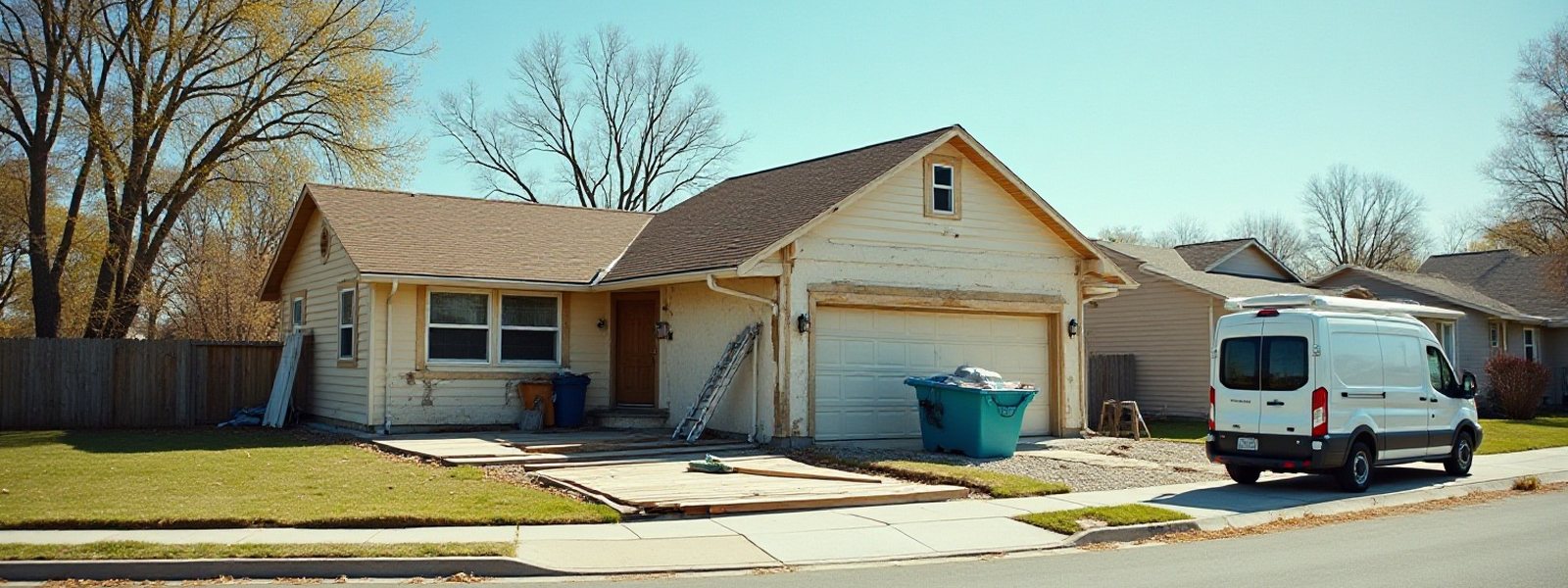
A first-time flipper can get a fix and flip loan. Nobody needs a track record to borrow. What a beginner gets is a different set of rules: a cap on the renovation budget, cash that must sit in the bank, a minimum profit the deal has to show on paper, and the lender's standard price rather than its best one. Those rules decide which house you can buy. Here they are, with a first flip worked to the dollar.
Most lenders say they fund beginners, and our lending partners do. The difference is in what they ask of a borrower with no finished flips, and it is spelled out in the lender's underwriting guidelines rather than on its sales page:
A renovation cap. A borrower with zero or one completed deals can budget no more than $40,000 for the rehab, and the lender prefers the rehab to cost no more than half the purchase price. That single rule steers a beginner away from gut jobs and toward houses that need paint, floors, fixtures and a kitchen refresh.
Reserves. At least $15,000 in the bank, shown before closing. It is there for the week the contractor finds rot under the bathroom floor.
A minimum profit. The projected profit has to be at least 10 percent of the loan amount. A deal that only works if everything goes right will not pass.
Standard pricing. 12.99 percent interest and 2.99 points. The 10.99 percent starting rate is available after two loans have been paid off in good standing with our lending partner; a first-time borrower should expect to start above it and earn the way down.
A floor on the house. The after-repair value has to be at least $100,000, the property should sit within about 45 to 60 minutes of a metro area of 200,000 people or more, and the lot can be no bigger than two acres.
None of these is a penalty. Together they describe the kind of first deal that tends to survive: a modest house, a cosmetic renovation, cash in reserve and a margin wide enough to absorb a mistake.
ATTOM's report on the first quarter of 2026, drawn from recorded sales deeds, gives a beginner three things worth knowing before choosing a house.
The price band matters more than the city. Flipped homes bought for $100,000 to $200,000 produced the strongest typical margin nationally, 32 percent. Homes bought for under $50,000 typically lost 14 percent. The cheapest house on the street is often cheap for a reason the renovation cannot fix, and a lender with a $100,000 after-repair floor will not finance it anyway.
"Profit" in the headlines is gross. The typical flip made $66,000 between purchase and resale, a 25.4 percent return, the first rise in nearly two years. ATTOM's figure leaves out the renovation, the financing and the selling costs, which it notes flipping veterans put at 20 to 33 percent of the after-repair value. Run that on a $150,000 house flipped at the typical margin: it resells for about $188,100, a gross of about $38,100, and 20 to 33 percent of the resale price is roughly $37,600 to $62,100. At the national average, a beginner paying standard rates breaks even at best. You need a better-than-average buy.
Some big markets barely work at all right now. Among metros of a million people or more, the smallest typical margins were in Austin (2 percent), Dallas (4.3), San Antonio (5.1) and Houston (7.2). On gross numbers that thin, the typical flip in those cities did not cover its own costs. The widest margins were in Pittsburgh (85.9 percent), Buffalo, Virginia Beach, Baltimore (65.9) and Philadelphia (62). But Philadelphia County and Baltimore County, which sit inside two of those metros, are among six counties where our lending partners cap leverage at 50 percent of value, so the strongest margins can come with the thinnest loans.
Here is a deal a first-time borrower could actually get financed. A three-bedroom house in need of cosmetic work costs $150,000. The renovation is budgeted at $35,000, under the $40,000 cap and under a quarter of the price. Recent sales of finished comparable homes support an after-repair value of $250,000.
The loan. The program lends up to 100 percent of cost but no more than 70 percent of after-repair value. Seventy percent of $250,000 is $175,000, below the $185,000 total cost, so the loan is $175,000 and you bring the other $10,000.
The cost of the money. Points at 2.99 percent: about $5,230 at closing. Interest at 12.99 percent, paid monthly on an interest-only loan: about $1,894 a month. At the national typical 165 days, roughly five and a half months, that is about $10,420.
Everything else. Assume buying costs of about 2 percent of the price ($3,000), taxes, insurance and utilities of about $400 a month while you hold it ($2,200), and commissions and seller closing costs of about 7 percent of the sale ($17,500). Your market's figures will differ; plug them in.
What is left. $250,000 sale, minus $150,000 purchase, $35,000 renovation, $5,230 points, $10,420 interest, $3,000, $2,200 and $17,500, leaves about $26,650. That clears the lender's 10 percent test, which on a $175,000 loan is $17,500. Every cost after the purchase came to about 29 percent of the resale price, squarely inside ATTOM's 20 to 33 percent range.
What you needed in cash. The $10,000 gap, the $5,230 in points and the $3,000 in buying costs: about $18,230 at closing. Then $15,000 in reserves, shown, not spent. Then the monthly interest until the sale.
First flips rarely run to plan. Keep the same house and let two ordinary things happen: the renovation runs 15 percent over budget, another $5,250 from your pocket because the loan does not grow with the overrun, and the sale takes three months longer, about $6,880 more in interest and holding costs. The profit drops from about $26,650 to about $14,500.
That is still a profit, and it is why the rules above exist. A $40,000 renovation cap keeps the overrun small. The $15,000 reserve covers it. The 10 percent minimum profit leaves room to be wrong. Now shrink the buy: had this deal been bought at the national typical margin rather than at a 67 percent spread between purchase and resale, the same two slips would have turned it into a loss.
The timeline deserves its own warning. The lender's guidelines describe nine months as the standard term, with an extension of up to three months that is available on request but not guaranteed. Five and a half months of work and sale fits inside nine with room. Eight and a half does not.
Form the LLC first. Our lending partners lend to an entity, an LLC, corporation or trust, generally with no more than three owners, and every owner of 30 percent or more personally guarantees the loan. Setting it up takes days to weeks, depending on your state, and should not be the thing that delays your closing.
Put the reserves somewhere you can show them. Two months of statements for the account holding your $15,000 and your closing cash is a common ask. Money that just arrived needs a paper trail.
Get a real bid before you count on a number. A $35,000 budget should come from a contractor who has walked the house, itemized by room, not from an online estimator. Renovation money is typically released in draws against that scope, after the work is inspected.
Pull the comparables yourself. The after-repair value sets both your loan and your profit. Use three or more recent sales of finished homes nearby, of similar size and age, and be suspicious of any one that makes your deal look better than the rest.
Know your credit history. The program's minimum score is 600, and a bankruptcy, foreclosure or short sale in the last 36 months generally makes a borrower ineligible. Check before an application finds it for you.
Stay out of it as a home. Fix and flip loans are business-purpose loans on non-owner-occupied property. If you or a family member plan to live in the house, this is the wrong loan.
Not every first flip should be sold. If the renovated house would rent well, a flip can become a rental by refinancing the short-term loan into a long-term DSCR loan sized on the rent, which returns much of your cash and keeps the property. It is a different set of numbers, worked through in our guide to getting a rental with little money down. Decide which exit you want before you buy, because it changes which house makes sense.
Yes. Our lending partners lend to first-time investors, and no completed flips are required. Experience changes the terms rather than the answer: a borrower with one or no completed deals has the renovation budget capped at $40,000 under the lender's guidelines, pays standard pricing, and has to show reserves and a projected profit before the loan is approved.
Our lending partners' fix and flip program lists a minimum score of 600. The lender also looks back for recent credit events: a bankruptcy, foreclosure or short sale within the last 36 months generally makes a borrower ineligible. Graduates of the lender's education programs can qualify for softer terms, including a lower score requirement.
More than the down payment. You need the part of the purchase and renovation the loan does not cover, the origination points, closing costs, the monthly interest while you work, and reserves the lender wants to see in the bank; our lending partners' guidelines call for $15,000. On the $150,000 house worked on this page that adds up to about $19,000 spent at closing plus $15,000 shown in reserves, with interest paid monthly on top.
Under our lending partners' guidelines, $40,000 for a borrower with zero or one completed deals, and the lender prefers the renovation to cost no more than half the purchase price. A bigger project has to wait until you have a few flips behind you, or bring a more experienced partner onto the deal.
The lender's program page lists loans up to 12 months, while its underwriting guidelines describe nine months as standard, with an extension of up to three more months that is available on request but not guaranteed. Plan for nine. ATTOM's data shows the typical flip nationally took 165 days from purchase to resale in early 2026, which fits, but leaves little room for a slow sale.
Yes. Our lending partners lend to entities, such as an LLC, a corporation or a trust, generally with no more than three owners. Every owner of 30 percent or more personally guarantees the loan, so the LLC organizes the deal rather than shielding you from it.
Market figures: ATTOM Q1 2026 U.S. Home Flipping Report, released June 18, 2026. Lending terms: our lending partners' published program page and underwriting guidelines; terms change, and we confirm them for your deal before you commit.
Thinking of keeping the house instead? Our two free landlord books cover what a rental costs to hold in each state.
Answer these and your deal goes to our lending partner's team, who will contact you about whether it is fundable and on what terms. By sending it you agree to your details being shared with them. Investment property only — our lending partners do not finance a home you will live in.
Thank you. Your details are on their way to our lending partner's team, who will contact you shortly.
Dominion Hard Money does not lend its own funds; it arranges financing through third-party lending partners. All financing is arranged for business purposes only and secured by non-owner-occupied investment property. Not a commitment to lend. All loans subject to underwriting, property review, and approval by the lender. Terms vary by property, borrower experience, and exit strategy.
The 70% rule and how rehab draws work · What hard money lenders ask for · Run your own numbers · Flipping with a credit problem · Choosing a lender