
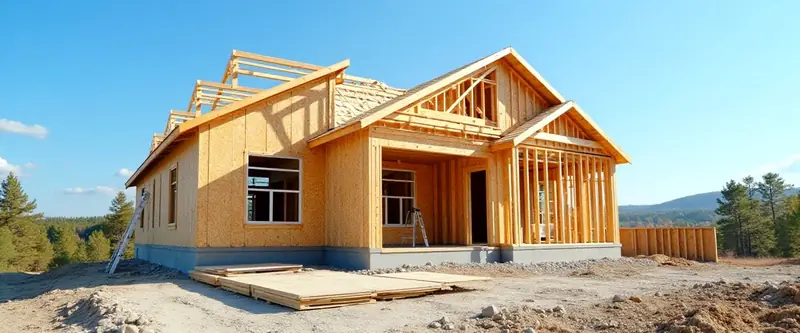
Here is how construction draws actually work, how long a build really takes, and what the money costs against the market.
The gap before the first draw is where builds die
Construction money is not handed over at closing. It is released in stages as milestones are completed and inspected, and that means the first phase of your build is funded by you.
Work through the order it actually happens in. Permits and impact fees are paid up front, by you. Site prep, clearing and grading, by you. The footings and foundation get poured and paid for, and only then does an inspector visit and authorize the first draw. If your foundation costs $40,000, that $40,000 needs to be in your account on day one. There is no draw called "foundation" that arrives at signing.
Then it repeats in miniature all the way through. Subcontractors expect to be paid when their scope is done, while each draw waits on an inspection and processing. That gap is real on every phase, not just the first, and the answer is a working capital reserve held specifically to bridge it. Builders who skip that reserve are the ones whose crews walk off site while they wait on a wire.
The last one catches almost everybody: the final draw is not available to finish the job. Lenders generally release it only when the work is substantially complete, often including landscaping, appliances and final cleaning. Builders planning to pay for those items out of the final draw discover they have to fund them first, at exactly the point the project feels finished.
How the draw schedule actually saves you money
The structure that creates the cash gap is also the thing that makes construction financing affordable, and it is worth understanding rather than resenting.
Residential projects commonly run four to six draws tied to milestones, foundation, framing, rough-in, drywall, completion, with an inspector verifying each before funds are released. Where interest is charged only on money actually drawn, a phased release costs far less than a lump sum.
Concretely, at 12.99 percent: if a $500,000 construction budget were funded in full at closing, nine months of interest would cost about $48,700. Drawn evenly across the same nine months, the average balance is about half, and interest comes to roughly $24,000 to $27,000, depending on when the draws land. Ask the lender, in writing, whether interest accrues on the full commitment or only on funds disbursed.
Some construction loans also fund an interest reserve at closing, covering the interest for the scheduled build period so you are not writing monthly checks out of working capital. The catch is what happens when you run past it: once the reserve is exhausted, interest comes out of your pocket monthly, at the worst possible moment in a project.
Have a lot and a set of plans?
Send the address, the budget with bids, the builder and your exit. Our lending partner's team reviews whether the project fits and on what terms. The lender makes every credit decision.
How long the build really takes
This is the number first-time spec builders get most wrong.
The Census Bureau's Survey of Construction, as analyzed by the National Association of Home Builders, found that a new single-family home took an average of 8.8 months in 2025 from permit to completion: about 1.4 months from authorization to start and 7.4 months to finish construction. That average is mostly experienced production builders. It does not include the weeks before the permit, and it does not include selling the house: of homes built for sale and completed in 2025, 31.5 percent sold only after completion.
So a first spec build should plan for permits, weather, supplier delays and inspection holds on top of the national average, and then for the time to sell or refinance. That is why the loan term matters more on construction than on any other product. A term that only fits the build on paper turns into an extension request, and extensions are at the lender's discretion and cost extra. Choose the term against the realistic schedule, not the hopeful one.
What the money costs, and how it compares
Through our lending partners, short-term construction is priced from 12.99 percent interest plus 2.99 points, with loans from $50,000, a minimum credit score of 600, and up to 100 percent of cost or 70 percent of value, whichever binds first. Leverage depends on the experience you can document over the past three years. It is non-owner-occupied, business-purpose lending to an LLC or corporation. Borrowers who have paid off two loans with the lending partner in good standing can qualify for loyalty pricing of 10.99 percent plus 1.99 points. Maximum loan size, term length and as-completed value requirements are set deal by deal, so confirm them with the lender for your project.
In the wider market, ground-up hard money in 2026 is commonly quoted in the low to mid teens with terms of 12 to 24 months, while banks price lower but ask for far more documentation, longer approvals and stricter builder requirements. Origination on private construction money commonly runs 1 to 3 points or more.
Budget for a construction appraisal as well. It usually costs more than a standard appraisal because the appraiser is estimating a completed value from plans and specifications rather than valuing something that exists.
The construction exit is usually a sale or a refinance into a long-term rental loan, so look at DSCR loans before you break ground if you might hold it.
What underwriting actually looks at
Construction is underwritten on the project and the people building it as much as on your tax returns.
The as-completed value. An appraiser produces it from your plans and comparable sales, and it drives the loan amount more than any other single input. If your finished-value assumption is not supported by recent comps in that specific neighborhood, the loan comes in smaller and the difference is cash you bring.
The budget. Itemized, line by line, with contractor bids behind it. Not a total.
Who is building it. Construction lenders want to see completed ground-up projects of similar scope, from you or from your builder. First-time builders can get financed, but the usual answer is to partner with a general contractor who has a genuine local track record. A first-time developer with a proven GC is a very different file from a first-time developer without one.
Your skin in the game. The part of the land and construction cost the loan does not cover, plus the liquidity to carry the pre-draw phase described above.
The exit. Selling the finished spec home, or refinancing into a DSCR rental loan. The lender needs to know which, with numbers, before funding, not after the certificate of occupancy.
What gets a construction deal declined
A nine-month timeline on a build that will take longer. Model the real duration, including the sale, and choose the term against it.
No working capital behind the loan. The pre-draw phase and the draw lag both need cash that is not loan proceeds.
A budget without bids. A number with no line items is not a construction budget.
An as-completed value built on optimistic comps. It sizes the entire loan. Get it right before you buy the lot.
A first-time builder with a first-time GC. One inexperienced party is manageable. Two is not.
A house you intend to live in. This is non-owner-occupied business-purpose lending only. Building your own home is a consumer construction loan and a different product entirely.
Keep reading
Pennsylvania · Maryland · DSCR loans · Loan calculator · How to vet a lender
Get your deal reviewed
Answer these and your deal goes to our lending partner's team, who will contact you about whether it is fundable and on what terms. By sending it you agree to your details being shared with them. Investment property only: our lending partners do not finance a home you will live in.
Got it.
Thank you. Your details are on their way to our lending partner's team, who will contact you shortly.
Construction loan questions
Can a first-time builder get a hard money construction loan?
Yes, with the right team. Bring a general contractor with completed local projects, an itemized budget with bids, and honest liquidity. Prior renovation experience counts for something with a private underwriter even if you have never built from the ground up. The lender makes the final decision.
How much cash do I need on day one of a construction loan?
The part of the land and build cost the loan does not cover, plus permits and impact fees, site prep and the foundation, all before the first draw. Then a working capital reserve to carry the gap between paying contractors and receiving each draw.
What does a hard money construction loan cost?
Through our lending partners, short-term construction starts at 12.99% interest plus 2.99 points; 10.99% plus 1.99 points is loyalty pricing for borrowers who have paid off two loans with the lending partner. Across the market, ground-up hard money in 2026 is commonly quoted in the low to mid teens.
What happens if my build runs past the loan term?
You ask for an extension, which is at the lender's discretion and usually costs a fee, with interest continuing. The better plan is a term with room in it for the build and the sale.
Can I roll the land purchase into a construction loan?
Often, yes. Construction lending commonly works on a loan-to-cost basis covering land plus the construction budget, capped against the as-completed value. Bring the lot details and the lending partner's team will tell you how the deal could be structured.
Should I sell the finished house or keep it as a rental?
Decide before you break ground: the two exits imply different finish levels, different price points and different buyers. If you plan to hold, check that the rent will support a DSCR refinance at today's rates.
Sources
- NAHB Eye on Housing, single-family home construction time declines in 2025 (Sept 2026), 8.8 months average, 1.4 months to start, 7.4 months to complete, and when built-for-sale homes sold (accessed Oct 2026)
- U.S. Census Bureau, New Residential Construction, length of time tables, underlying construction-time data (accessed Oct 2026)
- RentalRealEstate.com, hard money loans (updated April 2026), 2026 hard money rate, point and term ranges including ground-up construction (accessed Oct 2026)
- Lima One Capital, construction draw process explained, milestone draws and inspections (accessed Oct 2026)
Dominion Hard Money does not lend its own funds; it arranges financing through third-party lending partners. All financing is arranged for business purposes only and secured by non-owner-occupied investment property. Not a commitment to lend. All loans subject to underwriting, property review, and approval by the lender. Terms vary by property, borrower experience, and exit strategy.