
The property cannot earn a dollar until the paperwork clears
Maryland is two markets in one state, the high-priced Washington suburbs and the lower-priced Baltimore rowhouse market, and in both of them deals are won or lost on compliance and closing costs rather than on price alone. This is the sentence that should govern every Maryland pro forma.
Maryland requires owners of rental housing built before 1978 to register each unit with the Maryland Department of the Environment and comply with the state's lead risk reduction standard. From January 1, 2026, registration and renewal cover two years instead of one, with the fee rising from $30 to $75, and renewals are due by December 31 of the renewal year. Before every change in occupancy, the unit must pass an inspection by an accredited MDE inspection contractor and the owner must hold a current lead certificate. That is not a one-time step at purchase; it recurs each time a tenant moves out and another moves in.
Baltimore City layers its own rental license and inspection on top, and Baltimore County, Montgomery County and Prince George's County run their own licensing systems. Confirm the jurisdiction before you close rather than discovering the requirement after you have found a tenant.
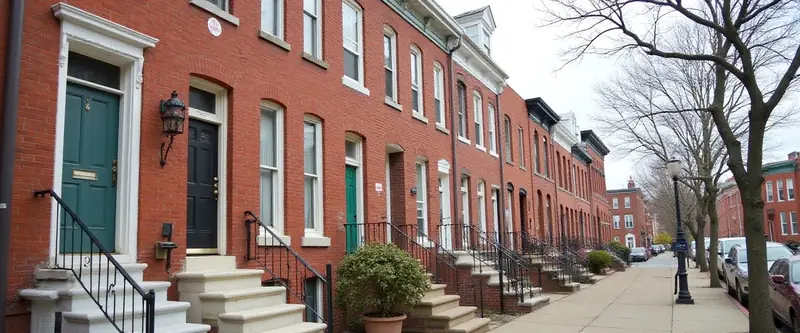
Now put that against the housing stock. Baltimore's rowhouse inventory is overwhelmingly older than 1978, so the lead certificate is not an edge case: it is the normal path, and it gates the rental license, which gates the tenancy, which gates the income. The financing consequence is direct. Compliance work belongs in the rehab budget and the inspection calendar belongs in the hold period.
Maryland's closing taxes, and why they matter twice on a flip
Maryland taxes the deed on several layers, and on a flip you can meet them at both closings.
State transfer tax: 0.5 percent of the consideration.
County or city transfer tax: set locally. In Baltimore City it is 1.5 percent, so the combined transfer tax there is 2 percent of the price.
Recordation tax: also local. Baltimore City charges $5 for each $500 of consideration, which is another 1 percent.
Who pays which share is set by the contract and local custom, but on a Baltimore City flip the total of transfer and recordation taxes can run about 3 percent of the price on the way in and again on the way out. On a $250,000 resale that is roughly $7,500. Put the figures for your county into the deal sheet before you write the offer; this is one of the biggest differences between a Maryland flip and one in a low-tax state.

Property tax on a Maryland rental
Maryland's Homestead Tax Credit limits how fast a home's taxable assessment can rise, to 10 percent a year or less depending on the county, but only on the one property the owner actually lives in. A rental never gets it. A seller who has owned a home for years may be paying tax on an assessment well below its current value; once you buy it as a rental, the protection is gone and the full assessment applies.
The rate matters too. Baltimore City's real property tax rate for fiscal 2026 is $2.248 per $100 of assessed value, the highest in the state, on top of the small state rate. On a rowhouse assessed at $200,000 the city portion alone is about $4,500 a year, and it sits inside the DSCR payment. A property clearing a healthy gross yield in Baltimore City is not clearing it net.
Many older Baltimore rowhouses sit on ground leases, where the buyer owns the house but owes a small annual ground rent to a separate holder. Since 2007 no new residential ground rents can be created, and holders had to register existing ones with the State Department of Assessments and Taxation; a ground rent that was not registered is not enforceable. Registered ones are, and an unpaid ground rent is a title problem that surfaces at closing or refinance. Have title search the SDAT registry on any older Baltimore purchase and put any ground rent in the operating numbers.
Have a deal on the table?
Send the address, the numbers and your exit. Our lending partner's team reviews it and tells you whether it fits and on what terms. The lender makes every credit decision.
Maryland landlord law: price the tenant-friendly rules
Maryland gives tenants more process than many states, and the cost of a bad tenancy is higher here as a result.
Ten-day notice before filing. Since October 1, 2021, a landlord must give written notice of intent to file a failure-to-pay-rent case and wait 10 days for the tenant to cure before filing in District Court (Real Property 8-401).
One month's deposit. The Renters' Rights and Stabilization Act of 2024 cut the maximum security deposit from two months' rent to one month's, effective October 1, 2024. The same law raised the filing surcharges on failure-to-pay-rent cases and requires the Maryland Tenants' Bill of Rights to be attached to every residential lease.
That does not make Maryland a bad market. It means screening, documentation and local management earn their keep, and a vacancy or contested eviction should be priced into a rental's numbers.
Foreclosure. Maryland forecloses through a trustee's sale that a circuit court must ratify. The borrower can stop the process by paying in full until the sale, but there is no statutory redemption period after the sale is ratified, which gives a buyer at a ratified sale more certainty than in states with long redemption windows.
How our lending partners size a Maryland loan
Fix and flip, rehab and bridge pricing starts at 12.99 percent plus 2.99 points. Borrowers who have paid off two loans with the lending partner in good standing can qualify for loyalty pricing of 10.99 percent plus 1.99 points. Loans start at $50,000, the minimum credit score is 600, and the loan can cover up to 100 percent of cost (purchase plus rehab) but no more than 70 percent of after-repair value, whichever binds first. Leverage depends on the projects you can document from the past three years. Property must be non-owner-occupied and held in an LLC or corporation.
For a rental, the DSCR program lends from $75,000 to $2 million, up to 80 percent of value on a purchase or rate-and-term refinance, with no minimum credit score. Run the ratio with the full assessment (no homestead credit), the local tax rate, a real insurance quote and any ground rent.
Term length is the thing to get right in Maryland. Between a rehab, an accredited lead inspection, a city license and a tenancy or a sale, a Baltimore rowhouse project uses more calendar than an equivalent project in a state without those steps. Ask the lender about the term for your deal and model the compliance calendar before you choose it. The lending partner's team confirms the terms for your property, and the lender decides.
What gets a Maryland deal declined
A pre-1978 rental with no lead plan. The most common Maryland failure. It recurs at every change of occupancy.
A license assumption based on the wrong jurisdiction. Baltimore City, Baltimore County and the Washington suburbs run different systems.
A flip budget with no transfer and recordation taxes. In Baltimore City they can reach about 3 percent at each closing.
Taxes taken from the seller's bill. The seller's Homestead Tax Credit does not transfer to a rental.
A primary residence. Our lending partners do not finance a home you intend to live in.
In Maryland the license gates the tenancy, and the tenancy is the income. See what a $400,000 rental costs to hold in Maryland, beside eleven other states.
Send it through the form above and our lending partner's team will review your deal.
Keep reading
Baltimore · Pennsylvania · Virginia · DSCR loans · Loan calculator · What lenders require
Get your deal reviewed
Answer these and your deal goes to our lending partner's team, who will contact you about whether it is fundable and on what terms. By sending it you agree to your details being shared with them. Investment property only: our lending partners do not finance a home you will live in.
Got it.
Thank you. Your details are on their way to our lending partner's team, who will contact you shortly.
Questions investors ask
Can I get a hard money loan for a Baltimore rowhouse flip?
Yes. Our lending partners review non-owner-occupied investment property in Baltimore City, Baltimore County, the Washington suburbs and the rest of Maryland, held in an LLC or corporation. Plan the lead work, the license and the closing taxes into the budget, and the lender decides each deal.
Can I close before the lead certificate is in hand?
Closing and compliance are separate. You can buy the property, but a pre-1978 unit has to be registered and pass the lead inspection before a tenant moves in, and in Baltimore City it needs the rental license too. Plan the loan term around the later of those, not the closing date.
How much are transfer taxes on a Baltimore City flip?
The state transfer tax is 0.5 percent, the city transfer tax 1.5 percent and the recordation tax $5 per $500, about 1 percent. Together that is about 3 percent of the price, split by contract and custom, and a flip meets it at both the purchase and the sale.
Why will my tax bill be higher than the seller's?
The Homestead Tax Credit, which caps annual assessment increases, applies only to an owner's principal residence. A rental pays on the full assessment, and in Baltimore City the rate is $2.248 per $100 for fiscal 2026.
How much security deposit can a Maryland landlord take?
One month's rent, since the Renters' Rights and Stabilization Act of 2024 took effect on October 1, 2024. Before that the cap was two months.
How long does an eviction for unpaid rent take to start in Maryland?
The landlord must first give written notice and wait 10 days for the tenant to pay before filing a failure-to-pay-rent case in District Court.
Sources
- Maryland Department of the Environment, rental property owner requirements, two-year registration from January 1, 2026, $75 fee, inspection before every change in occupancy (accessed Oct 2026)
- Baltimore City Department of Finance, transfer tax FAQ, 1.5 percent city and 0.5 percent state transfer tax (accessed Oct 2026)
- Baltimore City Department of Finance, recordation tax, $5 per $500 of consideration (accessed Oct 2026)
- Baltimore City Bureau of the Budget, city tax rates, real property rate of $2.248 per $100 (accessed Oct 2026)
- Maryland SDAT, Homestead Tax Credit, assessment cap only on the owner's principal residence (accessed Oct 2026)
- Maryland General Assembly, fiscal note on ground rent registration, registration with SDAT, unregistered ground rents unenforceable, no new ground rents since 2007 (accessed Oct 2026)
- Maryland Real Property 8-401, written notice and 10-day cure period before a failure-to-pay-rent filing (accessed Oct 2026)
- Maryland DHCD, Renters' Rights and Stabilization Act FAQ, one-month deposit cap and Tenants' Bill of Rights from October 1, 2024 (accessed Oct 2026)
- Appellate Court of Maryland, unreported opinion No. 1242 (2023 term), ratification of foreclosure sales and the equity of redemption (accessed Oct 2026)
Dominion Hard Money does not lend its own funds; it arranges financing through third-party lending partners. All financing is arranged for business purposes only and secured by non-owner-occupied investment property. Not a commitment to lend. All loans subject to underwriting, property review, and approval by the lender. Terms vary by property, borrower experience, and exit strategy.