
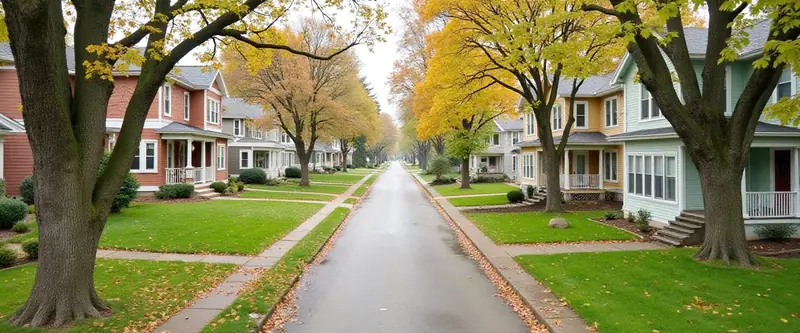
Here is what the three big metros do, what eats the difference, and how our lending partners size a loan against it.
The gross yield is real. So is everything that comes off it.
Cleveland is the market everyone cites, and the entry price is the reason. Redfin put the city's median sale price at about $142,000 for the three months to May 2026, up roughly 6 percent on a year earlier. When the denominator starts there instead of at $400,000, a modest rent produces a double-digit gross yield before the investor has done anything clever.
The gap between gross and net is where Ohio deals are won or lost, and three costs drive it.
Property tax is high, and a rental pays more of it. Census-based estimates compiled by SmartAsset put the effective rate near 1.9 percent of value in Cuyahoga County and around 1.5 percent in Franklin and Hamilton counties, well above the national average. Ohio then gives back part of the bill through two credits. The 10 percent nonbusiness credit applies to one to three family dwellings whether the owner lives there or rents them out. The extra 2.5 percent owner occupancy credit applies only to the owner's own home, so it leaves with the seller on the day you buy.
The housing stock is old. Much of the cheapest inventory in Cleveland, Toledo, Dayton and Akron is eighty to a hundred years old: older wiring, galvanized supply lines, aging roofs and wet basements. The capital expenditure line in an Ohio pro forma is not optional, and it is not small.
Cities regulate rentals directly. Cleveland requires landlords who do not live in the property to register each rental unit, and rentals built before 1978 need a Lead Safe certificate from an independent inspection, renewed on a two-year or twenty-year cycle depending on the work done. Cincinnati has required registration of every residential rental unit since September 2020 and runs a separate rental inspection program. Budget the inspections and the repairs they will find.

What Ohio gives back to a landlord
The landlord framework is among the more workable in the Midwest. State law requires a written notice to leave the premises at least three days before an eviction case is filed (Ohio Revised Code 1923.04), and the case then runs through municipal or county court. Since 2022, House Bill 430 has written a statewide ban on local rent control into Ohio's landlord-tenant chapter, so no city can cap rents.
Security deposits must be returned, with an itemized list of deductions, within 30 days after the tenancy ends and possession is returned (Ohio Revised Code 5321.16). One detail catches out-of-state owners: where a deposit is larger than $50 or one month's rent, whichever is greater, the excess earns 5 percent a year interest if the tenant stays six months or more. Most investors simply cap deposits at one month's rent.
For a buy-and-hold borrower, speed of remedy is money. A market with a high gross yield and a slow, unpredictable eviction is worse than one with a slightly lower yield and a short, defined one, and Ohio is generally the second kind.
Have a deal on the table?
Send the address, the numbers and your exit. Our lending partner's team reviews it and tells you whether it fits and on what terms. The lender makes every credit decision.
Three metros, three different businesses
Cleveland: the cash flow market
The lowest entry prices of the three, with rents that have held up, and the widest range of neighborhood quality. Ohio City, Tremont and the streets around University Circle command materially higher rents and higher renovation costs; the outer east and west side neighborhoods are cheaper to buy and harder to manage. Cleveland rewards buying right and managing tightly, and it punishes remote, absentee ownership more than most markets. Remember the Lead Safe certificate on any pre-1978 rental, and that Cuyahoga's tax rate is the highest of the three counties.
Columbus: the growth market that is still affordable
Ohio's one big city that has kept growing, with Ohio State's student and staff population in the rental pool and Intel's New Albany chip project on the eastern edge. That project is real but slower than first promised: Intel now expects the first fab to be completed around 2030 and operating by 2031, so underwrite today's rents, not the plant's future payroll. Columbus also levies a 2.5 percent municipal income tax on people who work in the city, which trims what tenants take home.
Cincinnati: the balanced one
Prices between Cleveland and Columbus, steady rental demand from a broad base of corporate headquarters, hospitals and the University of Cincinnati, and a 1.8 percent city earnings tax. Over-the-Rhine is the cautionary example: investors who bought early did very well, and investors buying the same story now are paying for a renewal that has already happened. Price the neighborhood you are in, not the one next door.
Closing costs and foreclosure in Ohio
The conveyance fee. Ohio charges a fee when a deed is transferred: a state levy of 1 mill under Revised Code 319.54 plus a county levy of up to 3 mills under 322.02. Many counties, Clermont and Ashtabula among them, charge the full $4 per $1,000; others charge less. By custom the seller usually pays it, which on a flip means you pay it on the way out.
Foreclosure is judicial. An Ohio lender files suit, gets a judgment and sells through a sheriff's sale. The borrower can redeem by paying the judgment and costs at any time before the court confirms the sale (Revised Code 2329.33), and there is no redemption period after confirmation. For an investor buying at sheriff's sale, that means title is not settled until confirmation, so arrange the money early and budget the wait.

How our lending partners size an Ohio loan
Fix and flip, rehab and bridge pricing starts at 12.99 percent plus 2.99 points. Borrowers who have paid off two loans with the lending partner in good standing can qualify for loyalty pricing of 10.99 percent plus 1.99 points. Loans start at $50,000, the minimum credit score is 600, and the loan can cover up to 100 percent of cost (purchase plus rehab) but no more than 70 percent of after-repair value, whichever limit binds first. How close you get to those limits depends on the projects you can document from the past three years. Property must be non-owner-occupied and held in an LLC or corporation.
The $50,000 floor matters more in Ohio than in most states. A house bought for $45,000 with a $25,000 rehab still clears it; a $35,000 cosmetic flip may not. Know where your loan lands before you rely on financing.
For a rental you plan to keep, the DSCR program qualifies on the rent rather than your income: loans of from $75,000 to $2 million, up to 80 percent of value on a purchase or rate-and-term refinance, with no minimum credit score. In Ohio, run the coverage ratio with the tax recalculated without the owner occupancy credit and with a real insurance quote.
A Columbus example: a house worth $250,000 after renovation supports up to $175,000 at 70 percent of value. If purchase and rehab together cost $190,000, the investor brings about $15,000 plus closing costs and the conveyance fee at resale. The lending partner's team decides the final terms on every deal.
What gets an Ohio deal declined
A rehab budget written from photos. Century-old stock hides its problems until demolition. Walk it, or send someone who will, and carry a contingency.
A gross yield used as a net yield. High taxes, real capex, vacancy and management come off the top. Underwrite the net.
Taxes taken from the seller's bill. The seller's bill includes the owner occupancy credit and often an older value. Model your own.
Ignoring rental registration and lead rules. An unregistered Cleveland or Cincinnati rental with open violations is a compliance problem that compounds, and it surfaces at refinance if not before.
A home you plan to live in. Our lending partners make business-purpose loans on investment property only.
City guides: hard money in Cleveland · hard money in Columbus · hard money in Cincinnati.
What a $400,000 rental costs to hold in Ohio, set against eleven other states.
Send it through the form above and our lending partner's team will review your deal.
Keep reading
Pennsylvania · Michigan · DSCR loans · Fix and flip loans · Loan calculator · Rates and terms
Get your deal reviewed
Answer these and your deal goes to our lending partner's team, who will contact you about whether it is fundable and on what terms. By sending it you agree to your details being shared with them. Investment property only: our lending partners do not finance a home you will live in.
Got it.
Thank you. Your details are on their way to our lending partner's team, who will contact you shortly.
Questions investors ask
Can I get a hard money loan anywhere in Ohio?
Our lending partners review investment property across Ohio, including Cleveland, Columbus, Cincinnati, Toledo, Dayton and Akron. The property must be non-owner-occupied and held in an entity, and the lender decides each deal on its numbers.
Is Cleveland really a 12 percent rental market?
Gross, it can be, because prices are low. Net is a different figure once Cuyahoga County's property tax, capex on old housing, vacancy and management come out, and the honest range depends on the condition of the specific building. Underwrite the net.
Do Ohio rentals get the property tax rollback?
Partly. The 10 percent nonbusiness credit applies to one to three family dwellings whether owner-occupied or rented. The extra 2.5 percent owner occupancy credit applies only to the owner's own home, so a rental loses it after the sale.
Do I need a lead certificate to rent a house in Cleveland?
Yes, for rental units built before 1978. Cleveland requires a Lead Safe certificate based on an independent inspection, plus rental registration for owners who do not live in the property. Check both before you close on a Cleveland rental.
Can I buy at an Ohio sheriff's sale with a hard money loan?
It is possible, but plan ahead. Ohio foreclosure is judicial, the deposit is due at the sale, and the former owner can redeem until the court confirms it. Talk to the lending partner's team well before the sale date.
Who pays the conveyance fee in Ohio?
Usually the seller, by custom. The fee is up to $4 per $1,000 depending on the county, so on a flip you pay it when you sell the finished house.
Sources
- Redfin, Cleveland housing market, median sale price about $142,000, three months to May 2026 (accessed Oct 2026)
- SmartAsset, Ohio property tax calculator, county effective tax rates for Cuyahoga, Franklin and Hamilton (accessed Oct 2026)
- Franklin County Auditor, owner occupancy credit, 2.5 percent credit limited to the owner's domicile (accessed Oct 2026)
- Lucas County Auditor, owner occupancy and nonbusiness credits, 10 percent nonbusiness credit applies to residential property (accessed Oct 2026)
- City of Cleveland, rental registration, registration and Lead Safe certificate for pre-1978 rentals (accessed Oct 2026)
- City of Cincinnati, residential rental registration and inspection, registration required since September 1, 2020 (accessed Oct 2026)
- Ohio Revised Code 1923.04, three-day notice before an eviction action (accessed Oct 2026)
- Ohio Revised Code 5321.16, security deposit return in 30 days and interest on excess deposits (accessed Oct 2026)
- Vorys, Ohio legislature acts to stop local rent control, House Bill 430 preemption of local rent control (accessed Oct 2026)
- Clermont County Auditor, real property transfer and conveyance, conveyance fee of $4 per $1,000 under Revised Code 319.54 and 322.02 (accessed Oct 2026)
- Nolo, Ohio foreclosure laws and procedures, judicial foreclosure and redemption before confirmation (accessed Oct 2026)
- Construction Dive, Intel delays New Albany project to 2030 and 2031, current Intel Ohio timeline (accessed Oct 2026)
- City of Columbus Auditor, 2026 revenue estimate, 2.5 percent municipal income tax (accessed Oct 2026)
Dominion Hard Money does not lend its own funds; it arranges financing through third-party lending partners. All financing is arranged for business purposes only and secured by non-owner-occupied investment property. Not a commitment to lend. All loans subject to underwriting, property review, and approval by the lender. Terms vary by property, borrower experience, and exit strategy.