
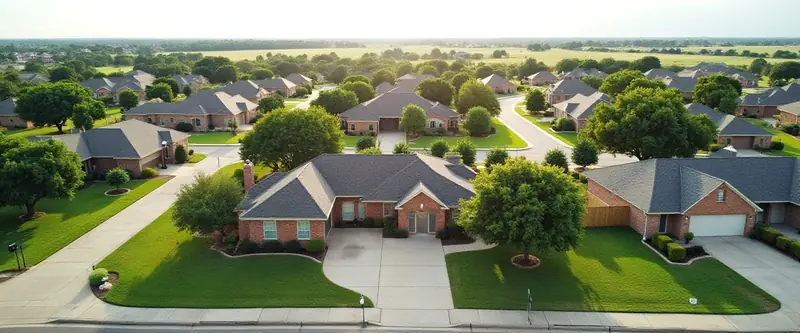
Here is how the tax works on an investment property, how the first Tuesday auctions and landlord rules affect a deal, and how our lending partners size the loan.
You pay for the missing income tax every month
Texas has no state personal income tax. It funds schools and local government largely through property tax instead, and the combined rate on a parcel (county, city, school district and special districts such as municipal utility districts) varies widely from one address to the next. Texas consistently ranks among the higher property tax states in the country.
The relief Texas does give is aimed at homeowners. The school district homestead exemption, the 10 percent annual cap on a homestead's appraised value, and the senior and disabled freezes all belong to an owner's primary residence. A rental gets none of them. So the seller's tax bill on a house they lived in tells you very little about yours.
Put an assumption on it. If the combined rate on your parcel is 2 percent, a $300,000 rental carries $6,000 a year, or $500 a month, before insurance. At 1.5 percent it is $375. Either way, the tax sits inside the DSCR payment, so a Texas rental needs more rent to reach the same coverage than an identical house in a lower-tax state.
Two habits follow. Look up the actual rates for the parcel from the county appraisal district and tax assessor, and model them on your purchase price, not the seller's appraised value. And protest every year: the appraisal review process is free to file and is one of the few operating costs you can argue down.

Insurance is the second squeeze
Hail across North and Central Texas, hurricane and windstorm exposure on the coast, and freeze claims have all pushed Texas premiums up. Along the Gulf Coast, many properties in designated catastrophe areas need windstorm coverage from the Texas Windstorm Insurance Association or a private carrier on top of a standard policy, and flood coverage is separate again. Get real quotes on the exact address during due diligence, and on a flip, get the builder's risk or vacant-property quote before you close.
Buying at a Texas foreclosure auction
Most Texas mortgage foreclosures are nonjudicial. Sales happen on the first Tuesday of the month at the place the county designates, usually the courthouse, after at least 21 days' posted notice (Texas Property Code 51.002). Buyers typically pay in certified funds at or soon after the sale, as the trustee directs, so the money has to be arranged before the auction, not after you win.
A standard mortgage foreclosure sale carries no right of redemption. Two kinds of sale do: a property-tax sale can be redeemed by the former owner, for up to two years on a homestead or agricultural land and 180 days on other property, and an HOA foreclosure on a home carries its own 180-day redemption right. Check which kind of sale you are bidding at.
A hard money loan is a common way to take a property bought at auction or off-market through renovation. Talk to the lending partner's team well before the auction date so the review is done before you bid.
Have a deal on the table?
Send the address, the numbers and your exit. Our lending partner's team reviews it and tells you whether it fits and on what terms. The lender makes every credit decision.
What Texas gives back to a landlord
A fast, defined eviction path. A landlord gives a written notice to vacate, three days under the Property Code unless the lease sets a different period, then files in justice court. Texas revised parts of its eviction procedure in 2025, so use current forms and timelines from the court.
No cap on security deposits. The deposit must be refunded, with an itemized list of deductions, within 30 days after the tenant surrenders the property (Property Code 92.103).
No rent control. State law bars cities and counties from adopting rent control except in a declared disaster with the governor's approval.
No state income tax on the profit. On a flip, the gain is a federal question only.
There is no statewide short-term rental statute. Austin requires an operating license, and Dallas and other cities restrict short-term rentals in many residential zones, with some rules tied up in litigation. If the exit depends on nightly rates, confirm the ordinance for that address and qualify the loan on long-term rent.
The four big metros run different races
Houston has no conventional zoning, a wide spread of entry prices and a job base across energy, health care, aerospace and the port. Flood zone and windstorm exposure matter more here than anywhere else in the state.
San Antonio offers some of the lowest entry prices of the four, with steady rental demand from the military, health care and financial services employers.
Dallas to Fort Worth is the most active market by volume, with corporate relocation behind it. Build after-repair values from the most recent closed sales; comps in parts of the metro have moved since their peak.
Austin is an appreciation market with thin rental yields at today's prices. Underwrite the exit conservatively and do not count on short-term rental income.
How our lending partners size a Texas loan
Fix and flip, rehab and bridge loans start at 12.99 percent plus 2.99 points. Loyalty pricing of 10.99 percent plus 1.99 points is available to borrowers who have paid off two loans with the lending partner in good standing. The minimum loan is $50,000 and the minimum credit score 600. The loan can cover up to 100 percent of cost (purchase plus rehab) and up to 70 percent of after-repair value, whichever binds first, and leverage depends on the projects you can document from the past three years. Property must be non-owner-occupied and held in an LLC or corporation.
Where comps are drifting, the 70 percent value limit is usually the one that binds. A house worth $280,000 after renovation supports up to $196,000; if purchase and rehab cost $215,000, the investor brings about $19,000 plus closing costs and carry.
For a hold, the DSCR rental program lends from $75,000 to $2 million, up to 80 percent of value on a purchase or rate-and-term refinance, with no minimum credit score. In Texas, run the ratio with the tax at the parcel's full non-homestead rate and a real insurance quote. The lender decides the final terms.
What gets a Texas deal declined
A tax figure lifted from the seller's bill. The most common modeling error in the state, because the seller's homestead relief does not transfer.
A sixty-day exit assumption. Budget the months of carry the current market actually needs.
An ARV built on stale comps. An appraisal gap means a smaller loan and more cash at closing.
An insurance quote you guessed at. Hail, wind and flood move Texas premiums more than square footage does.
A home you plan to live in. Our lending partners make business-purpose loans on investment property only.
City guides: hard money in Houston · hard money in Dallas · hard money in San Antonio · hard money in Austin · hard money in El Paso · hard money in Fort Worth.
Texas trades no state income tax for one of the heavier property tax bills in the country. See what a $400,000 rental costs to hold in Texas, next to eleven other states.
Send it through the form above and our lending partner's team will review your deal.
Keep reading
Oklahoma · Florida · DSCR loans · Fix and flip loans · Loan calculator · Rates and terms
Get your deal reviewed
Answer these and your deal goes to our lending partner's team, who will contact you about whether it is fundable and on what terms. By sending it you agree to your details being shared with them. Investment property only: our lending partners do not finance a home you will live in.
Got it.
Thank you. Your details are on their way to our lending partner's team, who will contact you shortly.
Questions investors ask
Can I use a hard money loan to buy at a Texas foreclosure auction?
Yes, if it is arranged in advance. Texas mortgage foreclosure sales happen on the first Tuesday of the month and buyers pay in certified funds as the trustee directs, so the lending partner's review needs to be done before you bid.
Why is my Texas rental's tax bill higher than the seller's?
Because the seller likely had a homestead exemption and the 10 percent homestead appraisal cap, and a rental gets neither. Your bill is also based on a value that reflects your purchase price.
Is there a redemption period after a Texas foreclosure?
Not after a standard mortgage foreclosure sale. Property-tax sales can be redeemed for up to two years on a homestead or farmland and 180 days on other property, and HOA foreclosures on homes carry a 180-day right.
Can I get a hard money loan anywhere in Texas?
Our lending partners review non-owner-occupied investment property across Texas, from Houston, Dallas to Fort Worth, San Antonio and Austin to El Paso and East Texas. The lender decides each deal on its numbers.
Which Texas metro is easiest for a first rental?
Usually San Antonio or parts of Houston, where entry prices are lower relative to rent. Austin is the hardest place in Texas to make a first rental cash flow at today's prices.
Sources
- Texas Property Code chapter 51, first Tuesday sales and 21-day notice under section 51.002 (accessed Oct 2026)
- Texas Tax Code chapter 34, redemption after a tax sale under section 34.21 (accessed Oct 2026)
- Texas Property Code chapter 209, redemption after a property owners' association foreclosure under section 209.011 (accessed Oct 2026)
- Texas Property Code chapter 24, notice to vacate under section 24.005 (accessed Oct 2026)
- Texas Property Code chapter 92, security deposit refund within 30 days under section 92.103 (accessed Oct 2026)
- Texas Local Government Code chapter 214, rent control prohibition under section 214.902 (accessed Oct 2026)
- Texas Comptroller, property tax exemptions, homestead exemption and appraisal cap limited to a residence homestead (accessed Oct 2026)
- Texas Windstorm Insurance Association, windstorm coverage in designated coastal areas (accessed Oct 2026)
- City of Austin, short-term rentals, operating license requirement (accessed Oct 2026)
Dominion Hard Money does not lend its own funds; it arranges financing through third-party lending partners. All financing is arranged for business purposes only and secured by non-owner-occupied investment property. Not a commitment to lend. All loans subject to underwriting, property review, and approval by the lender. Terms vary by property, borrower experience, and exit strategy.