
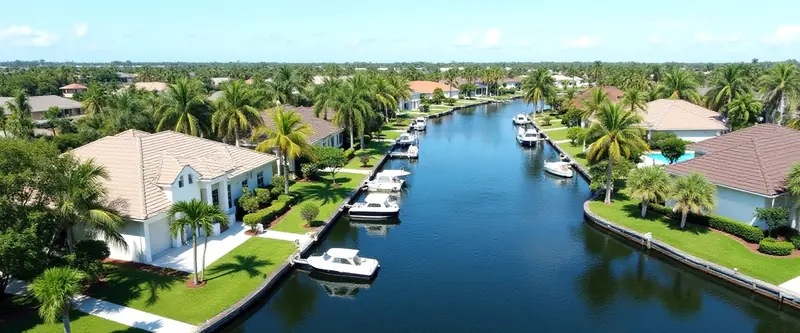
Florida is one of the busiest investor markets in the country and one where deals die on line items nobody modeled: the premium, the reset tax bill on a non-homestead house, and the doc stamps. This is what decides a Florida deal, and how our lending partners size the loan around it.
Insurance is the number that decides your deal
In most states, insurance is a modest line in the carry budget. In Florida it is a primary cost, and underwriting it casually is the most common way a competent investor turns a profitable project into a break-even one. Florida premiums run well above the national average, and the premium lands on you for the entire hold.
What drives the quote is the house, not the price: the wind zone, the distance from the coast, the age and type of the roof, the opening protection on windows and doors, and the flood zone. Two houses at the same price on different sides of a county can carry very different premiums.
Three Florida tools move the number. A wind mitigation inspection documents roof shape, roof-to-wall connections and opening protection, and Florida law requires insurers to offer discounts for those features. A roof replacement on an older house widens the list of carriers willing to quote. And if no private carrier will write the property, Citizens Property Insurance, the state-created insurer of last resort, may, at its own rates and eligibility rules. The My Safe Florida Home grant program is for homesteaded, owner-occupied homes, so an investor pays for upgrades out of pocket.
Two practical consequences. Get a real bindable quote before you close, not a rule-of-thumb estimate. And in the DSCR calculation, insurance sits inside the payment: a $400 monthly premium instead of $200 moves a 1.25 coverage ratio to roughly 1.10 on the same rent, which can change the loan you qualify for.
The tax bill resets when a house becomes a rental
Florida's low property taxes for homeowners come from two protections that an investor does not get. A homesteaded owner receives an exemption of up to $50,000 of assessed value, and the Save Our Homes cap limits annual increases in the homestead's assessed value to 3 percent or the inflation rate, whichever is lower. Long-time owners can be paying tax on a fraction of market value.
When an investor buys, both disappear. The assessment resets to market value as of the next January 1, and the property gets only the non-homestead cap, which limits annual assessment increases to 10 percent and applies to non-school taxes only. On a house a retiree has owned for twenty years, the new bill can be several times the seller's. Never budget from the seller's tax bill in Florida. Use the county property appraiser's estimator with your purchase price and no homestead.
Documentary stamp tax. Florida charges doc stamps on deeds at $0.70 per $100 of the price in most counties, with a different rate structure in Miami-Dade. The seller customarily pays it, so a flipper meets it on the exit. A new mortgage also carries doc stamps of $0.35 per $100 and a 0.2 percent intangible tax, which belong in the closing budget on the purchase.

In a soft market, model the value ceiling first
Florida prices are no longer rising everywhere. Several Gulf Coast and Southwest Florida markets have seen year-over-year declines and elevated inventory, while other metros are flat. That changes how a loan gets sized.
Our lending partners' fix-and-flip and bridge loans go up to 100 percent of cost and up to 70 percent of the after-repair value, whichever limit is reached first. On a Florida deal where the comparable sales are soft, the value limit is usually the one that binds, and that is the number to model first. If your exit price assumption is last year's comparable sale, the appraisal can come in lower, the loan smaller, and the shortfall lands on you at closing.
Have a deal on the table?
Send the address, the numbers and your exit. Our lending partner's team reviews it and tells you whether it fits and on what terms. The lender makes every credit decision.
Foreclosures, auctions and the right to redeem
Florida forecloses through the courts, and most foreclosure sales are now held online by the county clerk. The owner can redeem by paying the full amount due up to the time the clerk files the certificate of sale, or a later date if the judgment sets one. After that, the owner's right to redeem ends, and Florida has no long post-sale redemption period like Alabama's.
That makes a Florida auction purchase easier to insure than in redemption states, but the court process can be long, and a buyer still inherits liens that survive the sale, unpaid code enforcement fines and association balances in some cases. Have a title company review the docket and the lien search before you bid, and confirm with the lender before the auction whether it can fund the purchase on the timeline the clerk requires.
Florida landlord rules that shape a rental's numbers
Nonpayment. A Florida landlord can serve a three-day notice to pay or vacate, counting business days and excluding weekends and legal holidays, before filing an eviction. That is one of the faster timelines in the country.
Security deposits. Florida sets no statewide cap on the amount, but the landlord must disclose how the deposit is held and, after move-out, return it within 15 days or send written notice of a claim within 30 days.
Local rules. State law preempts local rent control and, since 2023, most local tenant ordinances, so the rules are largely the same from county to county.
Flood disclosure. Florida now requires landlords to disclose a property's known flood history and flood insurance information to tenants on longer leases. Ask the seller for flood history before you buy, because you will need it for the lease.
For a buy-and-hold investor these rules are favorable, which is why Florida rentals work well with a DSCR loan as long as the insurance and the non-homestead tax are priced honestly.
Where the numbers work
Statewide numbers hide everything that matters. These markets are running different races.
Lakeland and Polk County: the cash-flow play
Inland, between Tampa and Orlando, with lower entry prices than either and a logistics and distribution employment base along the I-4 corridor. Inland insurance is usually lower than coastal, which helps a rental clear its payment.
Jacksonville: big-metro entry at a lower price
One of the lower entry prices among Florida's large metros, with steady rental demand from the port, the Navy and health care. It is also the largest city by land area in the contiguous United States, so treating it as one market is the standard out-of-state mistake. Read the Jacksonville guide.
Orlando: yield with tourism exposure
Long-term rentals with a growing employment base, plus a short-term rental corridor near the parks with higher gross revenue, more seasonality and more regulation risk. Underwrite a short-term rental on long-term rent as the downside case. Read the Orlando guide.
Miami-Dade: two markets in one county
Houses here are still tight while condos have swung toward buyers, and the county has its own deed tax, its own surtax on anything bigger than a single-family home, and building recertification rules stricter than the state's. Read the Miami guide.
Tampa
Covered in depth on its own page, neighborhood by neighborhood. Read the Tampa breakdown.
Cape Coral and Fort Myers
Elevated inventory and falling prices give real negotiating leverage on the purchase. The same conditions make the exit slower and the appraisal riskier. Buy here on a wide margin or not at all.
Florida has no state personal income tax. On a flip, the profit you keep is higher than on the same deal in a state that taxes it, and that shows up directly in your return on cash.
What our lending partners offer in Florida
Dominion Hard Money does not lend its own funds; it arranges financing through third-party lending partners.
Fix and flip, rehab and bridge loans: standard pricing starts at 12.99 percent plus 2.99 points. Borrowers who have paid off two loans with the lending partner in good standing can qualify for loyalty pricing of 10.99 percent plus 1.99 points. Up to 70 percent of the after-repair value and up to 100 percent of cost, whichever limit is reached first, with leverage based on the projects you can document over the past three years. Minimum loan $50,000, minimum credit score 600.
DSCR rental loans: no minimum credit score, from $75,000 to $2 million, up to 80 percent of value on a purchase or rate-and-term refinance.
All loans are for non-owner-occupied investment property held in an LLC or corporation, and the lender makes every credit decision.
What gets a Florida deal declined
The older condo. After the Surfside collapse, Florida now requires milestone structural inspections and structural reserve studies for many condominium buildings, and associations that deferred maintenance are levying large special assessments. Single-family homes are the simpler collateral.
An insurance quote that arrives late. A binder that comes in at double your estimate days before closing kills the deal at the worst moment. Quote it during due diligence.
An after-repair value built on stale comparable sales. In markets that have softened, an old comp set produces an appraisal gap, a smaller loan and a bigger cash requirement.
A renovation scope with no contingency. On older Florida stock, code compliance, wind mitigation, roof age and electrical work tend to expand a scope after demolition starts. Ten to fifteen percent on top is not padding.
A home you will live in. Our lending partners finance non-owner-occupied investment property only.
City guides: hard money in Tampa · hard money in Orlando · hard money in Jacksonville · hard money in Miami.
What a $400,000 rental costs to hold in Florida: insurance is the line that decides the deal here, set out beside eleven other states.
Send it through the form above and our lending partner's team will review your deal.
Keep reading
Tampa · DSCR loans · Fix and flip loans · Loan calculator · Rates and terms
Get your deal reviewed
Answer these and your deal goes to our lending partner's team, who will contact you about whether it is fundable and on what terms. By sending it you agree to your details being shared with them. Investment property only: our lending partners do not finance a home you will live in.
Got it.
Thank you. Your details are on their way to our lending partner's team, who will contact you shortly.
Questions investors ask
Can I get a hard money loan anywhere in Florida?
Our lending partners review deals statewide, from the Panhandle to South Florida, subject to the property and the deal. Each loan is sized on the after-repair value, the cost and your experience, and the lender decides.
Why is the property tax on my Florida rental so much higher than the seller paid?
The seller likely had a homestead exemption and the Save Our Homes cap. A rental gets neither: the assessment resets to market value after the sale, and only the 10 percent non-homestead cap applies afterward, to non-school taxes.
How much are doc stamps on a Florida flip?
The deed tax is $0.70 per $100 of the price in most counties, customarily paid by the seller, so you meet it when you sell. A new mortgage adds $0.35 per $100 in doc stamps and a 0.2 percent intangible tax on the purchase.
Will a DSCR lender count short-term rental income in Florida?
It can be considered, but the safer approach is to qualify on long-term rent so a soft season or a local rule change does not put the loan underwater.
Does hurricane risk affect my hard money loan in Florida?
It affects the insurance, which affects the coverage ratio and the carry budget. Wind zone, roof age, opening protection and flood zone drive the premium more than the purchase price does, so get a bindable quote before you close.
Can I redeem or lose a Florida auction house after the sale?
The owner's right to redeem generally ends when the clerk files the certificate of sale, so there is no long post-sale redemption period. Liens that survive the sale and the court docket still need a title company's review before you bid.
Sources
- Florida Statutes 196.031, homestead exemption of up to $50,000
- Florida Statutes 193.155, Save Our Homes cap on homestead assessments and reset after a change of ownership
- Florida Statutes 193.1555, 10 percent cap on non-homestead residential assessments for non-school taxes
- Florida Department of Revenue, documentary stamp tax, deed and mortgage doc stamp rates
- Florida Statutes 45.0315, right of redemption until the certificate of sale is filed
- Florida Statutes 83.56, three-day notice for nonpayment of rent
- Florida Statutes 83.49, security deposit handling and return deadlines
- Florida Statutes 627.0629, required premium discounts for wind mitigation features
- Citizens Property Insurance Corporation, Florida's state-created insurer of last resort
- Florida Statutes 83.512, landlord flood disclosure for leases of one year or longer, from October 1, 2025 (accessed Oct 2026)
Dominion Hard Money does not lend its own funds; it arranges financing through third-party lending partners. All financing is arranged for business purposes only and secured by non-owner-occupied investment property. Not a commitment to lend. All loans subject to underwriting, property review, and approval by the lender. Terms vary by property, borrower experience, and exit strategy.