
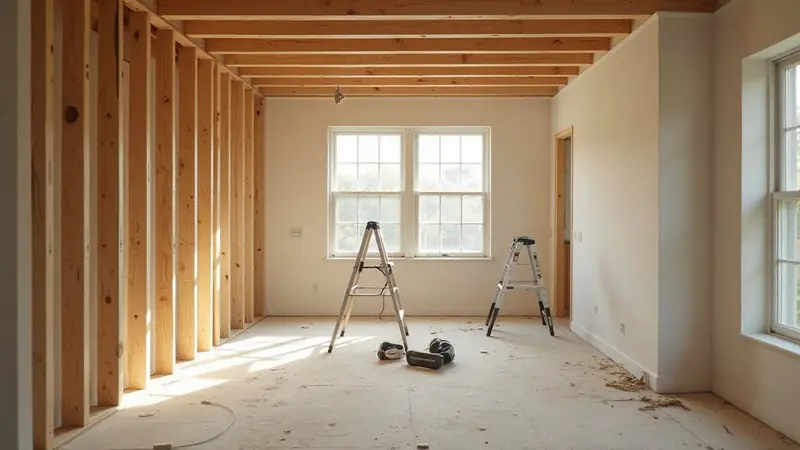
What a rehab loan is
A rehab loan finances the purchase and the renovation of an investment property in a single loan. The purchase money funds at closing. The renovation budget is held back by the lender and released in draws as each phase of work is completed and inspected. When the work is done, you sell the property or refinance into a long-term rental loan.
That structure solves the central problem of renovation investing. A bank will not lend on a house that needs a roof, new wiring and a gutted kitchen, because the property does not meet its condition and appraisal standards as it stands. A rehab lender looks at the after-repair value, what the property will be worth when the work is finished, and lends against that.
Through our lending partners, rehab loans follow the fix and flip program: standard pricing from 12.99% plus 2.99 points, a $50,000 minimum loan and a 600 minimum credit score, up to 100% of cost (purchase plus rehab) and up to 70% of the after-repair value, whichever is lower. Borrowers who have paid off two loans with the lending partner in good standing can qualify for 10.99% plus 1.99 points.
Rehab loan or a renovation mortgage?
Two government-related programs also pay for renovation, and investors ask about both. They are built for different borrowers.
If you have the time, the documents and a one-unit property, a conventional renovation loan will usually cost less. If the seller will not wait, the property will not appraise as it stands, or the plan is to sell, a rehab loan is the tool.
How the draw process works
The renovation budget is not handed to you at closing. The lender holds it and pays it out in stages that follow a draw schedule agreed before closing. Ask how many draws are included and what each inspection costs: market fees for a draw inspection commonly run in the low hundreds of dollars each, and they add up over four or five draws.
- Finish a phase of work. Demolition, rough-in, drywall, finishes: whatever the draw schedule defines as a stage.
- Request the draw. Send the draw request with photos showing the work is complete.
- Inspection. An inspector checks the completed work against the approved scope and its line items.
- Release. Once the inspection confirms the work, the lender releases that draw. Ask the lender how long a release takes after inspection and build that wait into your contractor's payment schedule.
The schedule protects both sides. The lender never pays for work that has not been done. You do not carry the whole renovation out of pocket, only enough working cash to finish each stage before it is reimbursed. Run short of that working cash and the job stops, so keep it in reserve.
Have a rehab with a written scope?
Send the address, the purchase price, the line-item budget and the after-repair value. Our lending partner's team reviews it against their rehab program. The lender makes every credit decision.
Writing a scope of work a lender will fund
The scope of work is the document the lender underwrites and the inspector checks against. A vague scope slows everything down. A specific one gets reviewed, funded and drawn without argument.
Every line needs a trade, a description and a dollar amount. "Kitchen renovation $31,000" is a lump sum nobody can inspect against. "Demolition $2,500, electrical rough-in $4,200, plumbing rough-in $3,800, cabinets and counters $8,500, flooring $3,200, appliances $4,500, paint and trim $2,800, fixtures $1,500" adds up to the same $31,000 and lets the inspector sign off item by item.
Add a contingency. HUD's own 203(k) renovation program builds in a contingency reserve of 10% to 20% of the repair costs, a useful benchmark for an investor budget, with the higher end for older houses and heavier work. Hidden water damage, wiring behind the walls and a foundation problem the inspection missed are the rule rather than the exception, and the lender will not increase the loan after closing.
What kills rehab deals
- Underestimating the budget. The most common mistake. A $40,000 budget on a house that needs $65,000 of work runs out of money halfway through, and the lender will not fund the gap. The project stalls with interest still running.
- Overestimating the after-repair value. The ARV sets the loan. If the house appraises at $280,000 instead of the $320,000 you projected, the loan shrinks and the margin can disappear. Use recent nearby sold comparables, not active listings.
- No contractor lined up. Lenders want to see a qualified contractor with written bids ready to start, not a plan to find one after closing.
- Scope creep. Work added after closing is not in the approved scope, so the draws do not cover it. It comes out of your pocket and adds time.
- Holding too long. Interest runs every month until the payoff. A four-month job that takes eight eats the profit in carrying costs, and margins are already thinner: ATTOM put the typical flip's gross margin at 21.5% in the second quarter of 2026, down from 27.6% a year earlier, before any financing or renovation costs.
Related guides
Fix and flip loans · How the holdback and payoff fit together · Hard money calculator · What hard money costs · Refinancing into a DSCR rental loan
Get your deal reviewed
Answer these and your deal goes to our lending partner's team, who will contact you about whether it is fundable and on what terms. By sending it you agree to your details being shared with them. Investment property only: our lending partners do not finance a home you will live in.
Got it.
Thank you. Your details are on their way to our lending partner's team, who will contact you shortly.
Rehab loan questions
What is a rehab loan for an investment property?
A single loan that pays for the purchase and the renovation of an investment property. The purchase funds at closing, and the renovation budget is held back and released in draws as work is completed and inspected.
How do rehab loan draws work?
You finish a stage of work, request the draw with photos, an inspector confirms the work against the scope, and the lender releases that amount. Ask the lender how many draws are included, what each inspection costs and how long a release takes.
How much of the rehab will a lender finance?
Our lending partners can finance up to 100% of cost, meaning purchase plus rehab, as long as the loan stays within 70% of the after-repair value. Whichever limit is lower decides the loan, and leverage depends on your documented experience.
Can I use an FHA 203(k) loan to rehab a rental?
Generally no. The 203(k) program is designed for owner-occupants. Investors usually choose between a conventional renovation loan, such as Fannie Mae HomeStyle on a one-unit property, and a business-purpose rehab loan.
What happens if my rehab goes over budget?
You cover the overage. The lender will not increase the loan after closing, so build a contingency of 10% to 20% into the budget from the start and keep working cash in reserve.
Sources
- HUD Handbook 4240.4, 203(k) rehabilitation mortgage insurance, owner-occupant focus of the program and the 10% to 20% contingency reserve (accessed Oct 2026)
- FDIC Affordable Mortgage Lending Guide, FHA 203(k) Rehabilitation Mortgage Insurance, program insures loans for owner-occupants (accessed Oct 2026)
- Fannie Mae Selling Guide B5-3.2-02, HomeStyle Renovation eligibility, one-unit investment property eligible (accessed Oct 2026)
- ATTOM, Q2 2026 U.S. Home Flipping Report, 21.5% typical gross flipping margin, down from 27.6% (accessed Oct 2026)
- FlipperForce, calculating financing costs, draw inspection fees charged per draw on rehab loans (accessed Oct 2026)
Dominion Hard Money does not lend its own funds; it arranges financing through third-party lending partners. All financing is arranged for business purposes only and secured by non-owner-occupied investment property. Not a commitment to lend. All loans subject to underwriting, property review, and approval by the lender. Terms vary by property, borrower experience, and exit strategy.