
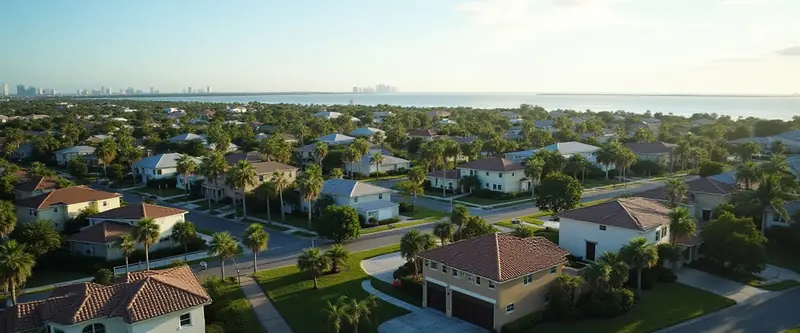
One county, two very different markets
Most people searching for hard money lenders in Miami are looking at one of two things: a house to fix and sell, or a condo to buy at a discount. In Miami-Dade those are two different bets, and the September 2026 numbers from MIAMI REALTORS show how far apart they have drifted.
Single-family houses are still tight. The median sale price was $692,000, up about 4 percent on a year earlier, with roughly a 5.1-month supply of listings. A typical house took 80 days from listing to closing.
Condos have tipped toward buyers. The median was $417,090, slightly down on the year, with about a 12.3-month supply and 102 days from listing to closing. Almost half of condo purchases closed in cash, against about a quarter of house purchases.
Two things follow. First, distressed sales were only about half of one percent of closings, so the discount in Miami rarely comes from a foreclosure. It comes from condition, from a building's problems, or from a seller who needs to move. Second, a condo flip has to be timed against a slow resale market. Count the months honestly before you borrow short-term money against it.
Check the building before you check the unit
Miami-Dade had a building recertification program decades before the 2021 Surfside collapse, and Surfside is in Miami-Dade. After the collapse the state created its own milestone inspection law for condominium and cooperative buildings, partly modeled on the county's program. The county says its own recertification reports are more demanding than the state's.
Under the county's current 30-year program, condo and co-op buildings built in 1998 or later that stand three stories or taller within three miles of the coast are recertified at 25 years of age, then every 10 years. Most other newer buildings are recertified at 30 years, then every 10 years. Older buildings already have their own deadlines on the county's schedule. The reports that count are the structural and the electrical.
For an investor, the practical rule is simple: ask the association for the building's recertification status, its milestone inspection, its structural integrity reserve study and any special assessment that has been voted or proposed. A unit priced well below its neighbors is often priced that way because of a repair bill the seller will not be paying. The lender reviewing your deal will ask the same questions, and so will whoever buys the unit from you.
Why Miami condo financing got harder in 2026
Your resale buyer matters as much as your purchase price. In September 2026 MIAMI REALTORS reported that only 21 of 2,397 condo buildings across Miami-Dade, Broward and Palm Beach counties, under 1 percent, were approved for FHA loans. It also reported that Fannie Mae and Freddie Mac ended the limited review option for many condo loans on August 3, 2026, which means more paperwork on the building before a buyer's conventional loan can close.
That shrinks the pool of buyers who can finance your unit when you sell it, which is part of why so many condo sales close in cash. It is also why some investors use short-term money to buy: a hard money lender looks at the property, the price and your plan rather than agency condo approval. Our lending partner's guidelines list condos as an eligible property type, and each building is reviewed with the deal. Send the building name with your numbers.
Found a Miami property?
Send the address, what you are paying, the repair budget and how you plan to repay the loan. Our lending partner's team will tell you whether it fits and on what terms. Every credit decision is the lender's.
Miami-Dade's closing taxes are not the same as the rest of Florida
Everywhere else in Florida, documentary stamp tax on a deed is 70 cents per $100 of the price. Miami-Dade charges 60 cents per $100, then adds a 45 cent per $100 surtax on any deed that transfers more than a single-family residence. A condo unit counts as a single-family residence; a duplex, a small apartment building or a commercial property does not.
Here is what that looks like at closing:
- A house at the September median of $692,000: 60 cents per $100 comes to $4,152 in deed stamps.
- A $600,000 duplex: the deed tax and the surtax together are $1.05 per $100, or $6,300.
- A $400,000 hard money loan: 35 cents per $100 on the mortgage is $1,400, and Florida's 0.2 percent nonrecurring intangible tax adds $800.
Who pays the deed stamps is set by your purchase contract, so read that line before you sign. The loan taxes are normally the borrower's. Either way, put every one of them in your closing budget so they are not a surprise on the settlement statement.
Insurance, flood and the tax bill after you buy
Flood coverage is becoming standard. If the property ends up insured through Citizens Property Insurance with wind coverage, a home in a FEMA Special Flood Hazard Area already needs flood insurance. Outside those zones the requirement has been phasing in by dwelling value: $400,000 and up from January 1, 2026, and every policy regardless of value from January 1, 2027. Condo unit-owner policies are exempt from this requirement, but houses and small multifamily buildings are not. Look up the address on the FEMA flood map and get quotes during your inspection period, not after closing.
Plan the property tax on your price, not the seller's bill. Florida caps yearly increases in the assessed value of non-homestead residential property at 10 percent, but the cap resets when the property sells. A seller who owned for years may have a much lower assessment than you will. If you plan to rent the property, that higher tax bill is part of the payment a DSCR lender will test against the rent.
Short-term rentals: confirm the address, not the neighborhood
Miami-Dade is not one set of rules. The county has 34 incorporated municipalities, plus large unincorporated areas, and each sets its own zoning. Miami Beach has restricted short-term rentals in its residential neighborhoods for years. It set a $20,000 fine for a first violation in 2016; in 2020 an appeals court ruled fines that large went beyond what state law allows, but left the rental restrictions themselves in place. Other cities allow nightly rentals only in certain zones or buildings, and many condo associations ban them outright.
Get the rule for your exact address in writing before you buy on a vacation-rental plan. If you will refinance into a DSCR rental loan, ask the lender whether it will count nightly-rental income at all, and run the numbers on a long-term lease as your fallback.
Our lending partners' terms for Miami deals
Fix and flip and bridge loans: standard pricing begins at 12.99 percent interest plus 2.99 points, interest only. Loans start at $50,000 with a 600 minimum credit score and can cover up to 100 percent of cost, capped at 70 percent of the after-repair value. Loyalty pricing of 10.99 percent plus 1.99 points is available only after two loans have been paid off with the lending partner in good standing.
DSCR rental loans: from $75,000 to $2 million, up to 80 percent of value, with no minimum credit score.
Miami-Dade is not one of the counties where the lending partner caps leverage at 50 percent of value. Properties need an after-repair value of at least $100,000, borrowers generally show at least $15,000 in reserves, and loans close in an entity such as an LLC or corporation on non-owner-occupied property. The lender decides every file and confirms terms for your property before you commit.
Planning to keep a Miami property as a rental? Our two free landlord books compare what a rental costs to carry across twelve states, Florida included.
Send it through the form below and our lending partner's team will tell you which program fits.
Related guides
Florida · Orlando · Tampa · Jacksonville · Fix and flip loans · DSCR rental loans · Rates and terms
Get your deal reviewed
Answer these and your deal goes to our lending partner's team, who will contact you about whether it is fundable and on what terms. By sending it you agree to your details being shared with them. Investment property only: our lending partners do not finance a home you will live in.
Got it.
Thank you. Your details are on their way to our lending partner's team, who will contact you shortly.
Questions Miami investors ask
How much do hard money lenders in Miami charge?
Our lending partner's standard pricing on fix and flip and bridge loans begins at 12.99 percent interest plus 2.99 points, interest only. Lower loyalty pricing applies only after two loans have been paid off with the lender. Budget for Miami-Dade's loan taxes too: 35 cents per $100 on the mortgage plus a 0.2 percent intangible tax.
Do hard money lenders require a down payment in Miami?
Often less than a bank, but rarely nothing. The loan can cover up to 100 percent of cost but no more than 70 percent of the after-repair value, so on many Miami deals the 70 percent cap decides how much cash you bring. Borrowers also generally need at least $15,000 in reserves.
Can I get a hard money loan on a Miami condo?
Condos are an eligible property type in our lending partner's guidelines, for non-owner-occupied investment use. Expect the building to be reviewed with the deal, so have the association's recertification status, milestone inspection, reserve study and any special assessments ready.
What closing taxes will I pay on a Miami-Dade purchase?
Deed stamps in Miami-Dade are 60 cents per $100, plus a 45 cent per $100 surtax unless the property is a single-family residence, which includes a condo unit. The loan adds 35 cents per $100 and a 0.2 percent intangible tax. Your contract sets who pays the deed stamps.
Can I use a DSCR loan on a Miami Beach vacation rental?
Check two things first. Miami Beach has long restricted short-term rentals in residential neighborhoods, and many condo associations ban them, so confirm the rule for the exact address. DSCR lenders also commonly qualify on long-term rent, so get written confirmation before counting nightly income.
Sources
- MIAMI REALTORS, September 2026 market report, median prices, supply, time to sale, cash share, distressed share and condo financing changes (accessed Oct 2026)
- Miami-Dade County, Building recertification update (September 2025), the 30-year program and the 25-year rule for coastal condo buildings (accessed Oct 2026)
- Florida Statutes section 553.899, the state milestone inspection law for condominium and cooperative buildings (accessed Oct 2026)
- Florida Department of Revenue, Documentary stamp tax overview, the 70 cent statewide deed rate, Miami-Dade's 60 cent rate, its 45 cent surtax and the 35 cent rate on mortgages (accessed Oct 2026)
- Florida Department of Revenue, Nonrecurring intangible tax, the 2 mill tax on mortgages (accessed Oct 2026)
- Citizens Property Insurance, Flood insurance requirement, the phased flood coverage requirement (accessed Oct 2026)
- Florida Statutes section 193.1554, the 10 percent assessment limit on non-homestead residential property and its reset on sale (accessed Oct 2026)
- Miami-Dade County, Municipalities, the county's 34 incorporated municipalities (accessed Oct 2026)
- City of Miami Beach, statement on short-term rental ordinances, the $20,000 first-violation fine and the court challenge (accessed Oct 2026)
- Avalara MyLodgeTax, report on the 2020 appeals court ruling, the fines struck down and the rental restrictions upheld (accessed Oct 2026)