
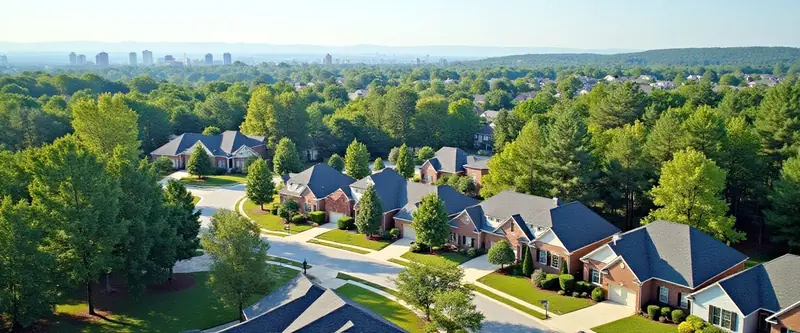
Fort Worth is its own market, with its own appraisal district
Fort Worth gets folded into "Dallas Fort Worth" in most national coverage, but the city is a market of its own. It has about a million residents, ranks as the 11th largest city in the country and covers 361 square miles. Most investors searching for hard money lenders in Fort Worth are buying in Tarrant County, which has its own appraisal district, its own tax rates and its own price level.
The most recent county figures from MetroTex Association of Realtors, for August 2026, put the Tarrant County median single-family sale price at $343,000, down 3 percent on a year earlier, with 1,736 sales, down 8 percent. Tarrant had 3.4 months of inventory. The wider North Texas region MetroTex reports on sat at 4.3 months, and Dallas County at 4.0 months with a $369,000 median.
So Fort Worth buyers are paying a little less than in the counties east of them, and the county has had less unsold supply than the region as a whole. By September, region-wide sales were down 7 percent on the year, pending sales were down 19 percent and the average home took 62 days to sell. A Fort Worth plan should assume a slower resale than the last few years taught, and count the months of interest honestly.
The tax value that has not moved since 2024
This is the part of a Fort Worth deal that is easy to miss right now. The Tarrant Appraisal District, which sets taxable values for property in Tarrant County, adopted a reappraisal plan that held residential values at their 2024 levels for the 2025 tax year, except for new construction and new improvements. The same plan says residential property will be reappraised only in odd-numbered years, starting in 2027. By September 2026 the district's board had adopted a 2027 to 2028 plan that keeps that odd-year schedule.
In practical terms, a house you buy in Fort Worth this year probably carries a tax value that reflects the market of 2024, and the next residential reappraisal is the one that lands in 2027. Chief Appraiser Joe Don Bobbitt has said he expects residential appraised values to rise about 15 percent on average in that reappraisal.
A homeowner living in the house is protected by the 10 percent yearly cap on a homestead. A rental gets no homestead cap. Texas also limits yearly increases on other property worth up to $5.32 million to 20 percent in 2026, but only after a full calendar year of ownership, and that limit is scheduled to expire after the 2026 tax year unless the Legislature renews it.
What a Fort Worth rental pays in property tax
Tarrant County publishes the rates each taxing unit adopted for 2026. For a parcel taxed by the City of Fort Worth and Fort Worth ISD, they look like this, per $100 of taxable value:
- Fort Worth ISD: $1.029099
- City of Fort Worth: $0.705650, up from $0.67 last year
- Tarrant County: $0.186000
- JPS Health Network (hospital district): $0.159000
- Tarrant County College District: $0.120000
- Tarrant Regional Water District: $0.027300
Together that is about $2.227 per $100, or roughly 2.23 percent of taxable value. A rental with a $300,000 taxable value would owe about $6,681 a year, or $557 a month. If that value rose 15 percent in 2027, to $345,000, the bill at the same rates would be about $7,683, roughly $84 a month more.
The total is different if your parcel sits in another school district or a special district, so check the tax statement for your exact parcel. Then run the DSCR math on the higher 2027 figure, not today's. If the rent only covers the payment at the 2024 tax value, the deal is thinner than it looks.
Working a Fort Worth deal?
Send the address, your price, the repair budget and how the loan gets repaid. Our lending partner's team will look at it and tell you whether it fits and on what terms. The lender makes every credit decision.
Protesting your Tarrant County value
Under the Texas Tax Code, the usual deadline to protest is May 15, or 30 days after your appraisal notice is delivered, whichever is later. The Tarrant Appraisal District recommends filing electronically through its online dashboard, which accepts evidence uploads and needs the property's Online Account PIN from your notice. You can also file by mail or in person.
For an investor, the best evidence is usually your own: the closing statement, photos of the condition you bought, and repair invoices. The appraisal district may not know what you paid, or what shape the house was in, unless you show it. If you bought a house that needed work, documenting that condition is how you argue the value down.

Fort Worth rental and short-term rental rules
Rental registration is mostly voluntary for houses. Fort Worth requires yearly registration of multi-unit complexes. For one- and two-family rentals, registration is voluntary unless the property has fire safety or public health and sanitation code violations, which makes it mandatory at $200 a year for each unit with violations. Owners who live outside Texas must name a local agent to accept legal service and a contact for local emergencies.
Nightly rentals are kept out of residential zones. Fort Worth does not allow short-term rentals in its residential zoning districts. They are allowed in mixed-use districts and most form-based, commercial and industrial districts. Where allowed, the property must be registered with the city before it is listed, at $150 for the first year and $100 to renew, and the operator collects a 9 percent hotel occupancy tax. In early 2025 a district court judge upheld the residential ban, and the plaintiffs said they would appeal.
If your plan is a vacation rental, confirm the zoning of the exact address first, and run the numbers on a long-term lease too. A DSCR rental loan is commonly qualified on long-term rent, so ask the lender in writing before you count nightly income.
How the loan math works on a Fort Worth flip
Texas has no transfer tax on a sale of real estate, which the state constitution prohibits, so a flip does not lose a slice of the price to the county when the deed changes hands. The pressure on a Fort Worth flip comes instead from the purchase discount and the months you carry.
Here is how our lending partner's limits would apply to an example house worth $320,000 after repairs, bought for $185,000 with a $55,000 rehab:
- Total cost: $185,000 plus $55,000 is $240,000.
- The 70 percent value limit: 70 percent of $320,000 is $224,000, which is lower than the cost, so it decides the loan.
- Your cash: about $16,000 toward the project, plus closing costs, plus reserves of generally at least $15,000.
- The cost of the money: at 12.99 percent plus 2.99 points, the points are about $6,698 and interest-only payments are about $2,425 a month.
Six months of interest on that loan is about $14,549. If the house takes three months longer to sell, the interest bill grows by about $7,274. That is why the after-repair value should come from recent closed sales in the same neighborhood, pulled by an agent, and why the hold should be budgeted at today's pace, not 2022's.
Our lending partner's terms for Fort Worth deals
Fix and flip and bridge loans are priced from 12.99 percent interest plus 2.99 points, interest only. The minimum loan is $50,000 and the minimum credit score is 600. The loan can cover up to 100 percent of cost, capped at 70 percent of the after-repair value. Loyalty pricing of 10.99 percent plus 1.99 points opens up only after two loans have been paid off with the lending partner in good standing.
DSCR rental loans run from $75,000 to $2 million, at up to 80 percent of value, with no minimum credit score.
Tarrant County is not among the counties where the lending partner caps leverage at 50 percent of value. The after-repair value must be at least $100,000, borrowers generally need at least $15,000 in reserves, and the loan closes in an LLC, corporation or trust on non-owner-occupied investment property. Single-family homes, condos, townhomes and two to four unit buildings are eligible. The lender reviews every file and confirms the terms for your property before you commit.
Keeping a Fort Worth house as a rental? Our two free landlord books compare what a rental costs to carry in twelve states, Texas included, property tax and all.
Send it through the form below and our lending partner's team will tell you which program fits.
Related guides
Texas · Dallas · Austin · Houston · San Antonio · Fix and flip loans · DSCR rental loans · Rates and terms
Get your deal reviewed
Answer these and your deal goes to our lending partner's team, who will contact you about whether it is fundable and on what terms. By sending it you agree to your details being shared with them. Investment property only: our lending partners do not finance a home you will live in.
Got it.
Thank you. Your details are on their way to our lending partner's team, who will contact you shortly.
Questions Fort Worth investors ask
How much do hard money lenders in Fort Worth charge?
Our lending partner's standard pricing on fix and flip and bridge loans begins at 12.99 percent interest plus 2.99 points, interest only. Lower loyalty pricing applies only after two loans have been paid off with the lending partner in good standing. Texas has no transfer tax on the deed, but budget for title, closing costs and the months of interest your project needs.
Do hard money lenders require a down payment in Fort Worth?
Usually some cash, though often less than a bank asks. The loan can cover up to 100 percent of purchase and rehab cost but no more than 70 percent of the after-repair value, so the 70 percent limit often decides what you bring. Borrowers also generally need at least $15,000 in reserves.
How do hard money lenders make money?
Mostly from points charged at closing and interest paid while the loan is out. On a $200,000 loan at 12.99 percent plus 2.99 points, the points are $5,980 and interest-only payments are about $2,165 a month. The lender also protects itself by lending against the property's value, not only your income.
Where can I find hard money lenders in Dallas Fort Worth?
Local investor meetups, real estate agents who work with investors and title companies all hear about lenders. You can also send your Fort Worth deal through our form: Dominion Hard Money does not lend its own funds, and passes your deal to its third-party lending partner, which decides every file.
Will my Fort Worth rental's appraised value jump in 2027?
It may. The Tarrant Appraisal District held most residential values at 2024 levels for 2025 and did not plan a residential reappraisal for 2026. Its chief appraiser has said he expects residential values to rise about 15 percent on average when reappraisal resumes. A rental gets no homestead cap, so budget for it and protest by May 15 or 30 days after your notice.
Can I run a short-term rental in a Fort Worth neighborhood?
Not in most of them. Fort Worth does not allow short-term rentals in its residential zoning districts. They are allowed in mixed-use and most form-based, commercial and industrial districts, with city registration and 9 percent hotel occupancy tax. Check the zoning of the exact address before you buy.
Sources
- City of Fort Worth, 2025 City Facts, population, national rank and land area (accessed Oct 2026)
- MetroTex Association of Realtors, August 2026 housing report, Tarrant, Dallas County and regional median prices, sales and months of inventory (accessed Oct 2026)
- MetroTex Association of Realtors, September 2026 housing market update, regional sales, pending sales and days on market (accessed Oct 2026)
- Tarrant Appraisal District, 2025 to 2026 Reappraisal Plan, residential values held at 2024 levels for 2025 and odd-year reappraisal from 2027 (accessed Oct 2026)
- The Texan, Tarrant Appraisal District adopts another two-year residential reappraisal cycle (September 2026), the 2027 to 2028 plan and the chief appraiser's expected 15 percent increase (accessed Oct 2026)
- Texas Comptroller, Valuing Property, the 10 percent homestead cap and the 20 percent non-homestead limitation (accessed Oct 2026)
- Harris Central Appraisal District, Circuit Breaker Cap, the $5.32 million 2026 threshold and the scheduled expiration (accessed Oct 2026)
- Tarrant County, Truth in Taxation Summary, 2026 adopted rates for the county, city, Fort Worth ISD, JPS, Tarrant County College and the water district (accessed Oct 2026)
- City of Fort Worth, FY2027 Budget, the adopted $0.705650 rate and the prior $0.67 rate (accessed Oct 2026)
- Texas Tax Code, Section 41.44, protest deadline (accessed Oct 2026)
- Tarrant Appraisal District, My Appraisal Notice, filing a protest online, by mail or in person (accessed Oct 2026)
- City of Fort Worth Code Compliance, Rental Registration, multi-unit registration, the $200 fee for one- and two-family rentals with violations and the local agent rule (accessed Oct 2026)
- City of Fort Worth, Short-Term Rentals, permitted zoning districts, registration fees and the 9 percent hotel occupancy tax (accessed Oct 2026)
- CBS News Texas, Fort Worth judge upholds ban on short-term rentals in residential areas (March 2025), the court ruling and planned appeal (accessed Oct 2026)
- Texas Legislature, S.J.R. 1 (84th Legislature), adding Article VIII, Section 29 to the Texas Constitution, prohibition of a transfer tax on a conveyance of real property (accessed Oct 2026)