
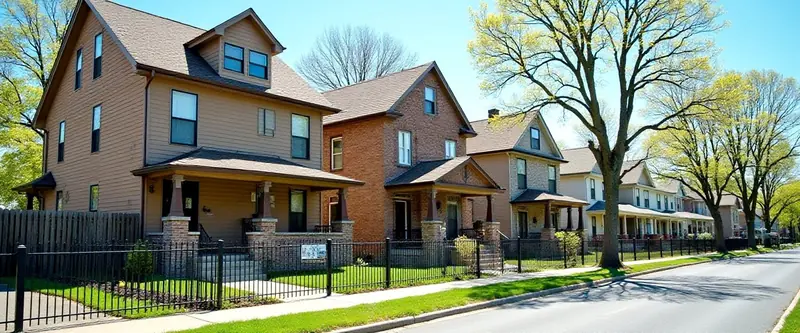
Cheap houses are not the same as financeable houses
Detroit is where many investors first go looking for hard money lenders, because the purchase prices look like a misprint next to almost anywhere else in the country. That low entry price is real. It is also the reason a lot of Detroit deals never make it to a loan.
Look at what actually sold. In Realcomp MLS data published by Real Estate One for the first eight months of 2026, Detroit recorded 3,023 single-family closings. Of those, 1,619 sold for under $100,000, a little more than half. Another 1,242 sold between $100,000 and $300,000, and 162 sold above $300,000. The average sale price over the period was $124,088.
The gap between the bands is the story. Houses under $100,000 sold for about $50 a square foot on average. Houses in the $100,000 to $300,000 band sold for about $113 a square foot, more than twice as much. Square footage does not explain a gap that wide. Condition and location do, and so does whether the house is in good enough shape for a buyer with a mortgage to purchase it.
That second band is where a renovation loan in Detroit lives. This page explains why, and how to plan a deal that our lending partner can actually review.
The two numbers that decide a Detroit deal
The $100,000 floor. Our lending partner requires an after-repair value of at least $100,000. A house that will be worth $85,000 when it is finished does not qualify, however cheaply you buy it and however good the margin looks. With more than half of Detroit's single-family sales closing under that line, a large share of the listings an out-of-state investor sees will never fit, and it is better to know that before you sign a purchase agreement.
The 50 percent cap. Detroit is in Wayne County, and Wayne County is one of the counties where our lending partner caps leverage at 50 percent of value. Elsewhere the fix and flip program can reach up to 100 percent of cost, limited to 70 percent of after-repair value. In Wayne County the 50 percent cap applies instead, so you should expect to bring roughly half the money yourself.
The cap is county-wide. It covers Dearborn, Livonia, Westland, the Grosse Pointes and every other Wayne County community, not only the city. Oakland and Macomb counties, just across Eight Mile Road, are not on the capped list, so a deal in Ferndale, Royal Oak or Warren is sized on the standard terms. Confirm with the lender which value the 50 percent is measured against for your file before you count on a loan amount.
Put the two rules together with the $50,000 minimum loan and the math is short. At 50 percent, a $50,000 loan needs a property worth at least $100,000. Detroit deals that work with this lender are full renovations that finish at or above that line, on blocks where finished houses actually sell for it.
A worked Detroit example
Say you buy a vacant three-bedroom brick house for $60,000 and budget $55,000 to renovate it, for a total cost of $115,000. Renovated houses on that block have recently sold for about $160,000, so that is your after-repair value. It clears the $100,000 floor.
- Outside Wayne County, 70 percent of the $160,000 after-repair value is $112,000, so the loan could cover most of the $115,000 cost.
- In Detroit, if the 50 percent cap is measured against the $160,000 after-repair value, the loan tops out at $80,000. You fund the other $35,000 of the cost, plus closing costs, plus reserves, which are generally at least $15,000.
- If the lender measures against the $60,000 purchase price instead, 50 percent is $30,000, which is below the $50,000 minimum loan, and the deal does not fit this program at all.
Either way, an investor planning a Detroit flip needs real cash, not a no-money-down plan. When you resell at $160,000, Wayne County's transfer taxes of 55 cents per $500 for the county and $3.75 per $500 for the state come to $1,376, a cost the seller customarily pays in Michigan. The Michigan guide covers how those taxes work and why a rental's property tax will run well above the seller's bill.
Have a Detroit house that finishes above $100,000?
Send the address, your purchase price, the renovation budget, the sold comparables you used for the after-repair value, and how much cash you can put in. Our lending partner's team will tell you whether it fits under the Wayne County cap. The lender makes every credit decision.
Where Detroit's cheap houses come from
A lot of Detroit inventory reaches investors through two public channels. Both have rules that affect financing, so read them before you plan to borrow.
The Detroit Land Bank Authority. The land bank sells houses through its auction and Own It Now programs. To buy, you must have no delinquent property taxes in Wayne County, no outstanding blight or code violations with the City of Detroit, and must not have lost a property other than a primary residence to unpaid taxes in Wayne County in the past three years. Companies can buy if they are authorized to do business in Michigan and submit a certificate of good standing. The buyer gets a quitclaim deed, but the land bank keeps an interest in the house until the renovation is complete, and the buyer signs a reconveyance deed that lets the land bank take the property back for failing its compliance requirements. Expect to upload photos of the work on a regular schedule after closing and to have the house occupied when you are done.
That retained interest matters to anyone lending on the property. If you plan to finance the renovation, tell the lender up front that the land bank holds an interest until you earn its release, and ask whether it can lend on that basis.
The Wayne County tax foreclosure auction. Each fall the Wayne County Treasurer auctions tax-foreclosed properties online, first in September and then again in October for what did not sell. Properties are first offered to government bodies, including the city. Minimum bids are the delinquent taxes, penalties and interest, buyers receive a quitclaim deed, and everything is sold as is with no warranties. Talk to a title company about insuring the deed before you bid, and run the after-repair value on finished comparable sales, not on the auction price.
No rent until the city signs off
Many Detroit flips end up as rentals, especially when a resale takes longer than planned. Before a Detroit house can produce legal rent, it needs a rental registration and a Certificate of Compliance from the city's Buildings, Safety Engineering and Environmental Department (BSEED). Registration and the certificate are now handled together, and the requirement applies citywide.
The steps, according to the city's landlord guide:
- Register the property as a rental online through the city.
- Pass a condition inspection. For one and two unit properties you schedule it with an approved inspection company; three or more units are scheduled with BSEED. The checklist covers items such as heat that reaches 68 degrees, hot water between 110 and 140 degrees, smoke and carbon monoxide detectors, egress, working locks, electrical safety and paint condition. Every item must pass.
- Handle lead if the house was built before 1978. The city's lead ordinance requires a lead inspection and risk assessment on those rentals, and a lead clearance after any hazard control work before the certificate is issued.
Operating without a certificate brings tickets starting at $400, liens for unpaid tickets, and the right for tenants to pay rent into a city escrow instead of to you. Under the amendments the city council passed in 2024, your first certificate is valid for three years, and a renewal filed before it expires runs for five.
For a DSCR rental loan, this is a timing question. Build the inspection, any lead work and the certificate into your renovation schedule, so the house is ready to lease, and the rent you are counting on is legal, by the time you refinance.

Building a Detroit deal that can be financed
Put together, the rules point to a narrower, more careful way to invest in Detroit with borrowed money:
- Start from the finished value. Pull sold, renovated comparables on the same few blocks. If they do not support at least $100,000, stop there, however cheap the house is.
- Size your cash to the Wayne County cap. Plan on funding about half the deal yourself, plus closing costs and at least $15,000 in reserves. If that is more cash than you have, look at a deal across the county line or a smaller project you can fund outright.
- Clean up your own record first. Unpaid Wayne County taxes or open Detroit blight tickets will keep you out of land bank sales.
- Put the rental certificate in the schedule. Inspection, lead work and the certificate belong in the renovation timeline, not after it.
- Buy in an entity. The lender requires an LLC, corporation or trust, and the land bank requires a company to be in good standing in Michigan.
What our lending partner offers on Detroit deals
Fix and flip and bridge loans: standard pricing begins at 12.99 percent interest plus 2.99 points, interest only. The minimum loan is $50,000 and the minimum credit score is 600. In most counties the loan can cover up to 100 percent of cost, capped at 70 percent of the after-repair value. Loyalty pricing of 10.99 percent plus 1.99 points opens up only after two loans have been paid off with the lending partner in good standing.
DSCR rental loans: from $75,000 to $2 million, up to 80 percent of value, with no minimum credit score.
In Detroit and the rest of Wayne County, leverage is capped at 50 percent of value. Every property needs an after-repair value of at least $100,000. Borrowers generally show at least $15,000 in reserves, and the property must be non-owner-occupied and held in an LLC, corporation or trust. Condos, townhomes and one to four unit buildings are eligible. The lender reviews each file and confirms the terms for your property before you commit.
Thinking of holding a Detroit house as a rental? Our two free landlord books compare what a rental costs to carry across twelve states, Michigan included.
Send it through the form below with your sold comparables and our lending partner's team will tell you whether it fits.
Related guides
Michigan · Cleveland · Philadelphia · Indianapolis · Ohio · Fix and flip loans · DSCR rental loans · Hard money requirements
Get your deal reviewed
Answer these and your deal goes to our lending partner's team, who will contact you about whether it is fundable and on what terms. By sending it you agree to your details being shared with them. Investment property only: our lending partners do not finance a home you will live in.
Got it.
Thank you. Your details are on their way to our lending partner's team, who will contact you shortly.
Questions Detroit investors ask
How much do hard money lenders in Detroit charge?
Our lending partner's standard pricing on fix and flip and bridge loans begins at 12.99 percent interest plus 2.99 points, interest only. Lower loyalty pricing applies only after two loans have been paid off with the lender in good standing. The lender sets final terms for each file.
Do hard money lenders require a down payment in Detroit?
With our lending partner, expect to. Detroit is in Wayne County, where the lender caps leverage at 50 percent of value, so plan on funding roughly half the deal yourself, plus closing costs and generally at least $15,000 in reserves.
Can I get a hard money loan on a cheap Detroit house?
Only if the finished house will be worth at least $100,000, which is our lending partner's minimum after-repair value, and the loan needed is at least $50,000. More than half of Detroit's single-family sales in 2026 closed under $100,000, so many low-priced houses will not qualify.
Can I finance a Detroit Land Bank house?
Possibly. The land bank keeps an interest in the house until the renovation is complete and the buyer signs a reconveyance deed, so tell the lender about it up front and ask whether it can lend on that basis. The lender decides each deal.
Is hard money lending legal in Michigan?
Yes. Michigan law allows business entities to borrow on interest terms agreed in writing, within the limits the statutes set, and private loans on investment property are common. Dominion Hard Money does not lend its own funds; it connects investors with a third-party lending partner, which makes every credit decision.
Where do I find hard money lenders for Detroit deals?
Start with a lender that actually works in Wayne County and say up front that the property is in Detroit, because county rules such as our lending partner's 50 percent cap change the loan size. Send your deal through the form on this page to have it reviewed.
Sources
- Real Estate One, September 2026 Southeast Michigan housing report (Realcomp MLS data), Detroit single-family closings by price band, average price and price per square foot through August 31, 2026 (accessed Oct 2026)
- Wayne County Register of Deeds, Document recording, county transfer tax of 55 cents per $500 and state transfer tax of $3.75 per $500 (accessed Oct 2026)
- Detroit Land Bank Authority, Frequently asked questions, auction and Own It Now buyer eligibility, company buyers, quitclaim deed, retained interest and reconveyance deed (accessed Oct 2026)
- Detroit Land Bank Authority, Compliance, photo reporting after closing and the release of interest on completion (accessed Oct 2026)
- Wayne County Treasurer, Auctions and claims, the September and October tax foreclosure auctions, minimum bids, government first offer and quitclaim deeds (accessed Oct 2026)
- City of Detroit, Rental code enforced citywide, the citywide rental registration and Certificate of Compliance requirement (accessed Oct 2026)
- City of Detroit BSEED, Landlord quick reference guide, registration, inspection steps and checklist, tickets from $400, liens and rent escrow (accessed Oct 2026)
- City of Detroit BSEED, Landlord rental requirements, registration and the Certificate of Compliance combined into one application (accessed Oct 2026)
- City of Detroit, Lead ordinance requirements for rental property owners, lead inspection and risk assessment for rentals built before 1978 and lead clearance before a certificate (accessed Oct 2026)
- MCL 438.61, Michigan Legislature, written interest rate agreements on credit extended to business entities (accessed Oct 2026)
- City of Detroit, rental ordinance update (August 2025), the three-year first certificate and five-year renewal (accessed Oct 2026)
- Planet Detroit, Detroit City Council rental ordinance reform (October 2024), the 2024 amendments and the three-year certificate (accessed Oct 2026)