
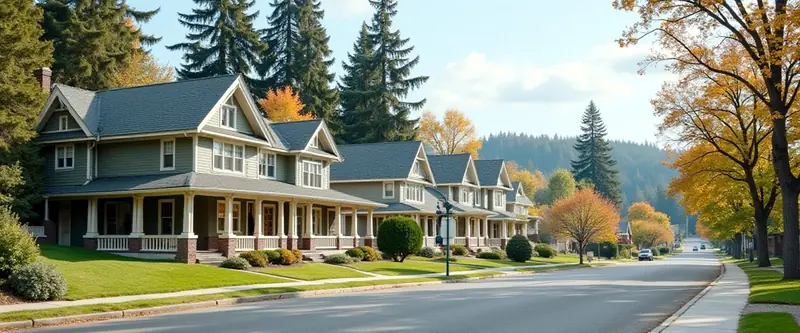
Here is what the law does to a rental's numbers, what the real estate excise tax costs a flip, how trustee sales work, and how our lending partners size a loan.
Your rent growth now has a legal ceiling
House Bill 1217, signed in May 2025, limits annual rent increases for most residential tenancies in Washington to 7 percent plus inflation or 10 percent, whichever is lower. The Department of Commerce publishes the figure each year, and for 2026 it is 9.683 percent.
The mechanics matter as much as the number. Rent cannot be raised during the first twelve months of a tenancy, and only once in any twelve-month period after that. Every increase needs at least 90 days' written notice statewide, and Seattle requires 180. Exemptions exist, including newer buildings within twelve years of their first certificate of occupancy and certain owner-occupied small properties, and the exemption has to be stated in the increase notice.
What that does to underwriting is simple. A pro forma that needs a 12 or 15 percent increase in year two to work cannot be executed in Washington. Build rent growth inside the cap, once a year, after the first twelve months, and confirm how the cap applies to your specific property with a Washington attorney.
Just cause and the notices that come with it
Since 2021, Washington has required a listed cause to end most residential tenancies, so a landlord cannot simply decline to renew a tenant who is paying and following the lease. For unpaid rent, the landlord serves a 14-day notice to pay or vacate before filing. Security deposits must be returned, with a full and specific statement of any deductions, within 30 days after the tenancy ends.
Seattle, Tacoma and Spokane have each added their own rules on top of the state framework, and Seattle's are the most extensive. On a small portfolio, the most likely place to get hurt is a notice that does not follow the required form.
What a Washington flip pays the state
Washington's real estate excise tax is graduated and paid by the seller. The state rate is 1.1 percent on the portion of the price up to $525,000, with higher rates on the slices above that, and most cities and counties add a local excise tax of up to 0.5 percent. On a $500,000 resale in a city charging the full local rate, that is about $8,000.
On the other side of the ledger: Washington has no personal income tax, and the state's capital gains tax does not apply to real estate. On a flip, the profit you keep is mostly a federal question.
Washington foreclosures are usually nonjudicial trustee sales under the Deeds of Trust Act, and there is no right of redemption after a nonjudicial sale. That makes trustee sales a workable source of inventory for a buyer with financing arranged in advance.
Have a deal on the table?
Send the address, the numbers and your exit. Our lending partner's team reviews it and tells you whether it fits and on what terms. The lender makes every credit decision.
Three markets, and the gap is mostly price
Seattle
The highest prices in the state, strong tenant quality and the heaviest local rules. At current prices most rentals do not cash flow on day one, and rent growth forecasts sit inside the cap, so price, not the cap, is the binding constraint. Treat Seattle as an appreciation and tenant-quality market.
Tacoma
Materially cheaper than Seattle, drawing Puget Sound commuters, with local rules lighter than Seattle's but real. For an investor who wants Puget Sound demand without Seattle prices, this is the compromise.
Spokane
The lowest entry prices of the three and the place where a DSCR ratio is easiest to build. It is also where compliance risk is quietly highest, because owners are smaller: a solo landlord faces the same notice rules and rent cap as an institutional operator, without the legal team.
What the cap means for a flip
If you buy, renovate and sell, the rent cap does not touch you directly. It reaches you through your buyer. An owner-occupant is unaffected; a landlord buyer is pricing your house against a rent that cannot be pushed the way it once could. Know which buyer you are building for, and price the excise tax and the months of carry into the exit.
How our lending partners size a Washington loan
Fix and flip, rehab and bridge loans are priced from 12.99 percent plus 2.99 points. Loyalty pricing of 10.99 percent plus 1.99 points is available after two loans paid off with the lending partner in good standing. The minimum loan is $50,000, the minimum credit score 600, and the loan can cover up to 100 percent of cost and up to 70 percent of after-repair value, whichever binds first, with leverage based on experience documented over the past three years. Property must be non-owner-occupied and held in an LLC or corporation.
The DSCR rental program lends from $75,000 to $2 million, up to 80 percent of value on a purchase or rate-and-term refinance, with no minimum credit score. That covers most Washington single-family rentals but not everything at the top of the King County market, so check early which program fits.
A Tacoma example: a house worth $520,000 after renovation supports up to $364,000 at 70 percent of value. If purchase and rehab cost $400,000, the investor brings about $36,000 plus closing costs and reserves. The lender decides the final terms.
What gets a Washington deal declined
A rent-growth assumption above the cap. Not merely optimistic; not permitted.
A Seattle rental underwritten for cash flow. At current prices the income rarely carries the purchase.
Compliance treated as paperwork. A defective notice can cost you months.
An exit with no excise tax in it. The seller pays it, and on a flip the seller is you.
A home you plan to live in. Our lending partners make business-purpose loans on investment property only.
Washington caps rent increases, with exemptions that decide whether the cap touches your property at all. See what a $400,000 rental costs to hold in Washington, next to eleven other states.
Send it through the form above and our lending partner's team will review your deal.
Keep reading
Colorado · DSCR loans · Fix and flip loans · Loan calculator · How to vet a lender
Get your deal reviewed
Answer these and your deal goes to our lending partner's team, who will contact you about whether it is fundable and on what terms. By sending it you agree to your details being shared with them. Investment property only: our lending partners do not finance a home you will live in.
Got it.
Thank you. Your details are on their way to our lending partner's team, who will contact you shortly.
Questions investors ask
How much can I raise rent in Washington in 2026?
For most tenancies, up to 9.683 percent, once in any twelve months and not during the first twelve months of a tenancy, with at least 90 days' notice (180 in Seattle). Some newer buildings and small owner-occupied properties are exempt.
Does the rent cap apply to my property?
Most residential tenancies are covered. Buildings within twelve years of their first certificate of occupancy and certain owner-occupied small properties are exempt, but the exemption must be stated in the increase notice. Confirm your property with a Washington attorney.
Who pays the real estate excise tax in Washington?
The seller. The state rate is 1.1 percent on the first $525,000 of the price and higher above that, plus a local rate of up to 0.5 percent in most places. On a flip, you pay it when you sell.
Seattle or Spokane for a first Washington rental?
Spokane, on most measures that matter to a first rental: lower entry prices and a rent that is more likely to cover the payment. Seattle suits a different objective and a bigger balance sheet.
Can I get a hard money loan anywhere in Washington?
Our lending partners review non-owner-occupied investment property across the state, from the Puget Sound metros to Spokane and the Tri-Cities. The lender decides each deal on its numbers.
Sources
- Washington State Department of Commerce, rent stabilization, 2026 maximum increase of 9.683 percent and notice requirements (accessed Oct 2026)
- Washington Legislature, House Bill 1217 (2025), rent increase cap, twelve-month rule and exemptions (accessed Oct 2026)
- RCW 59.18.650, causes required to end a tenancy (accessed Oct 2026)
- RCW 59.12.030, 14-day notice to pay or vacate (accessed Oct 2026)
- RCW 59.18.280, security deposit return within 30 days (accessed Oct 2026)
- Washington Department of Revenue, real estate excise tax, graduated state rates and local REET (accessed Oct 2026)
- Washington Department of Revenue, capital gains tax, real estate excluded (accessed Oct 2026)
- RCW 61.24, Deeds of Trust Act, nonjudicial trustee sales (accessed Oct 2026)
- Washington Department of Commerce, Commerce announces 9.683% rent cap for 2026, the 2026 figure and the 12-year new construction exemption (accessed Oct 2026)
Dominion Hard Money does not lend its own funds; it arranges financing through third-party lending partners. All financing is arranged for business purposes only and secured by non-owner-occupied investment property. Not a commitment to lend. All loans subject to underwriting, property review, and approval by the lender. Terms vary by property, borrower experience, and exit strategy.