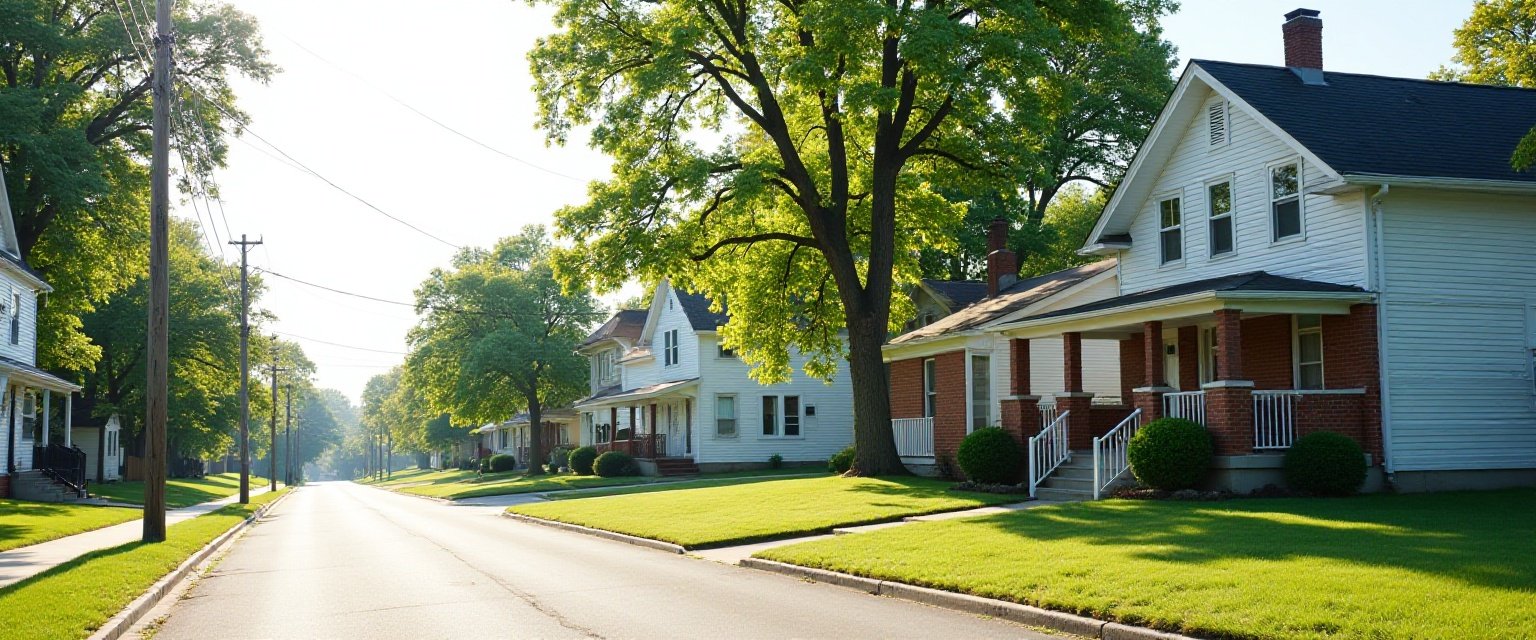
Indiana is one of the few states where an investor can work out the most a rental will ever pay in property tax before buying it, because the ceiling is written into the state constitution. Combined with some of the lowest entry prices of any big Midwestern metro, that makes the arithmetic here unusually predictable, provided you know where the traps are.
Since 2010 the Indiana Constitution has capped property taxes as a share of a property's gross assessed value: 1 percent for a homestead the owner lives in, 2 percent for other residential property, including rentals, and 3 percent for commercial property. When the tax rates in a district would produce a bigger bill, the excess is wiped off as a circuit breaker credit.
For an investor, that means a hard upper limit. A rental assessed at $200,000 cannot be billed more than about $4,000 a year in ordinary property tax, whatever the local rates do. The one exception to know about: taxes that voters approve in a referendum, usually for schools, are added on top of the cap.
Two things are changing the picture. First, the 2025 reform law, Senate Enrolled Act 1, created a new deduction for properties in the 2 percent category. It started at 6 percent of assessed value in 2025 and phases up to 33.4 percent by 2030, which lowers the taxable value of rentals over time. Second, tax rates are expected to rise. Purdue economist Larry DeBoer's analysis for the Indiana Fiscal Policy Institute projects the statewide average rate climbing from $2.38 per $100 of assessed value in 2025 to above $3 by 2031.
Put together, more rentals, especially in high-rate areas like Marion County, will sit right at the cap. That is good news for underwriting: in those places the cap is effectively the bill, and you can budget for it with confidence. Check the property's class code on the county assessment notice to confirm it is taxed as residential rather than commercial, and never rely on the seller's bill. A homeowner's bill reflects the 1 percent cap and homestead deductions a rental does not get.
The city of Indianapolis is where most Indiana investor activity happens, and the entry prices are the reason. Redfin put the city's median sale price at about $260,000 for the three months to July 2026, up 2.3 percent on a year earlier, with homes selling in around 21 days against 16 the year before.
That median hides a huge range. In Redfin's February 2026 figures, downtown Indianapolis sat near $360,000 while West Indianapolis was near $134,000 and the southeast side near $198,000, down double digits on a year earlier. Those are different markets that happen to share a city limit, and an ARV built on the citywide number is wrong almost everywhere.
The suburbs are the other end of the scale. F.C. Tucker's June 2026 report put the median for the 16-county central Indiana region at a record $323,250, and Hamilton County — Carmel, Fishers, Noblesville and Westfield — at $474,900 for the year to date. Inventory across the region was up almost 15 percent on a year earlier, and up more than 60 percent in Madison County, around Anderson.
The practical split: inside the city, the question is whether the numbers survive the neighborhood you are actually in. In the northern suburbs, the question is whether your renovation budget and resale price leave enough margin at those higher prices.

Indiana is one of the states where our lending partners pay placement fees, and none of its counties is on the lender's restricted list. The published fix-and-flip and bridge programs run up to 70 percent of the property's value, with a minimum loan of $50,000, terms of up to twelve months and a minimum credit score of 600. The published starting rate is 10.99 percent plus 1.99 origination points.
The 10.99 percent starting rate is available after two loans have been paid off in good standing with our lending partner; a first-time borrower should expect to start above it and earn the way down.
The loan minimum matters more in Indiana than almost anywhere, because so much inventory is cheap. At 70 percent of value, a house worth $70,000 supports a loan of about $49,000 — under the minimum. So the lowest-priced houses in the state are often outside what a hard money loan can finance at all. The lender's underwriting guidelines go further and set a minimum after-repair value of $100,000, so that is the real floor, and the deals with room to breathe are higher still.
Above that line, the Indiana numbers are straightforward. Take a West Indianapolis house worth $150,000 after renovation. Seventy percent is $105,000. If purchase and renovation together cost $120,000, the investor brings the difference plus closing costs and reserves — and the property tax on it, once it is a rental, is capped at about $3,000 a year before any referendum taxes.
1. Work out the tax ceiling. Two percent of gross assessed value, plus any referendum taxes in that district. Ignore the seller's bill.
2. Check the after-repair value clears the loan minimum. The lender's guidelines set a minimum after-repair value of $100,000. Below that, a hard money loan may not be available at all.
3. Price it by neighborhood, not by city. Inside Indianapolis the same citywide median covers houses from $134,000 to $360,000. Use renovated, comparable sales close by.
4. Pull the flood map for the exact address. Properties near the White River and Fall Creek can carry flood insurance and disclosure costs that belong in the budget.
5. Get written contractor bids and add at least ten percent for what older Indianapolis housing hides behind the walls.
6. Budget five or six months of holding costs, not the 21-day sale the headline figure suggests. Inventory is rising across the region.
7. Decide your exit before you buy. If you may keep it as a rental, check that the rent covers a DSCR payment including the capped tax and real insurance.
A loan below the minimum. The cheapest houses often cannot support a $50,000 loan at 70 percent of value.
An ARV from a citywide median. Indianapolis neighborhoods differ by more than $200,000.
A tax figure copied from a homeowner's bill. The rental cap is double the homestead cap, and the homestead deductions disappear.
No reserves. The lender needs to see cash to carry the loan if the sale runs long.
A home you plan to live in. Our lending partners cannot finance an owner-occupied property. That is federal law, not preference.
Our lending partners publish rates starting at 10.99 percent plus 1.99 origination points, available to repeat borrowers with two loans paid off in good standing. A first-time borrower should expect to start higher. Appraisal, title and closing costs are additional.
Yes, across Marion County and the surrounding counties, including Carmel, Fishers, Noblesville and Westfield in Hamilton County. Each deal is underwritten on its own neighborhood's sales, not the metro average.
The published minimum loan is $50,000. Because loans are capped at a share of value, the lender's underwriting guidelines also set a minimum after-repair value of $100,000, which is the practical floor.
In practice, yes. The loan is capped at a share of the property's value, so most deals need the investor to bring cash for part of the purchase and closing costs, plus reserves.
Yes. Private, business-purpose loans secured by investment property are a normal part of the market. Lenders and anyone arranging loans are still subject to state and federal law, so ask any lender for its licensing details and confirm them. This is general information, not legal advice.
They are expensive and short, so the danger is almost always the exit, not the loan. A deal that only works if the house sells fast at a high price is the risk. Build the budget on a slower sale and real costs, and the loan is a tool rather than a trap.
Want the long version? Two free landlord books cover what a rental really costs to hold and what the new federal housing law actually changed.
Answer these and we will tell you whether it is fundable, on what terms, and how fast it could close. Investment property only — our lending partners do not finance a home you will live in.
We will run the numbers and come back to you. If it is time-sensitive, call 903-636-7511.
Dominion Hard Money does not lend its own funds; it arranges financing through third-party lending partners. All financing is arranged for business purposes only and secured by non-owner-occupied investment property. Not a commitment to lend. All loans subject to underwriting, property review, and approval by the lender. Terms vary by property, borrower experience, and exit strategy.
Ohio · Michigan · Fix and flip loans · DSCR loans · Loan calculator · Rates and terms